Pet Food Manufacturer - OEM/ODM & Private Label

Low-Temperature Baked Pet Food: How It’s Made, Benefits & How It Compares With Extruded Food
Pet owners are paying closer attention to what goes into their pets’ food—but ingredients are only part of the story. How pet food is processed can also influence its texture, palatability, physical structure, shelf stability, and final nutritional profile.
That is one reason low-temperature baked pet food has attracted growing attention among premium pet food brands and buyers.
Instead of relying solely on conventional extrusion, baked pet food uses a controlled baking process to transform a formulated mixture of proteins, fats, carbohydrates, vitamins, minerals, and other ingredients into shelf-stable dry food.
But does “baked” automatically mean better? How is it different from extruded kibble? And what should pet food brands actually evaluate when comparing the two?
This guide explains the process, potential advantages, limitations, and the questions buyers should ask before choosing a baked pet food formula.
What Is Low-Temperature Baked Pet Food?
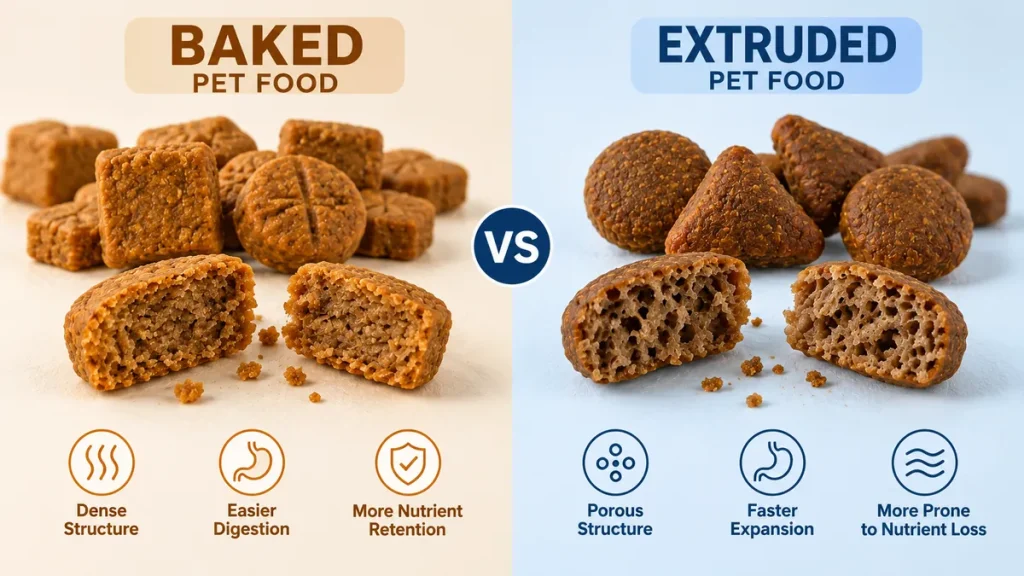
Low-temperature baked pet food is a type of dry pet food produced through a controlled baking process rather than the high-shear extrusion process commonly used for conventional kibble.
The exact temperature, moisture level, baking duration, formulation, and post-processing steps vary between manufacturers. Therefore, “low-temperature baked” should not be treated as a universal technical specification.
The important distinction is the processing method.
In extrusion, a formulated mixture is conditioned with heat and moisture, moved through an extruder under mechanical shear and pressure, shaped through a die, and subsequently dried.
Baked food follows a different path. The prepared mixture is formed and heated more gradually in a baking system until the required product structure and moisture characteristics are achieved.
For buyers, this distinction matters because processing conditions can affect kibble density, expansion, texture, ingredient behavior, and formulation possibilities.
How Is Low-Temperature Baked Pet Food Made?
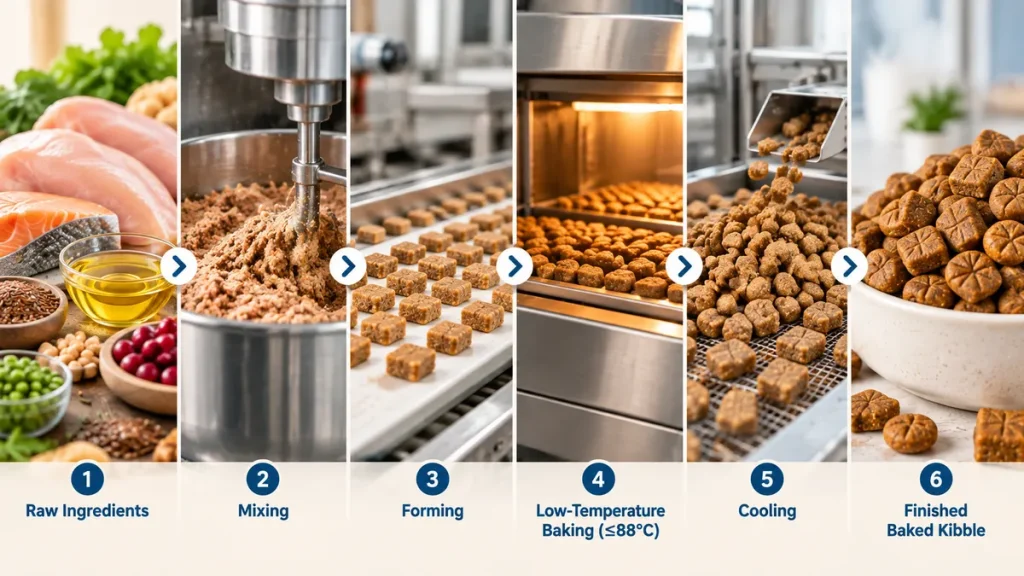
Although production systems differ between factories, a typical baked dry pet food process includes several key stages.
1. Ingredient Selection and Formula Development
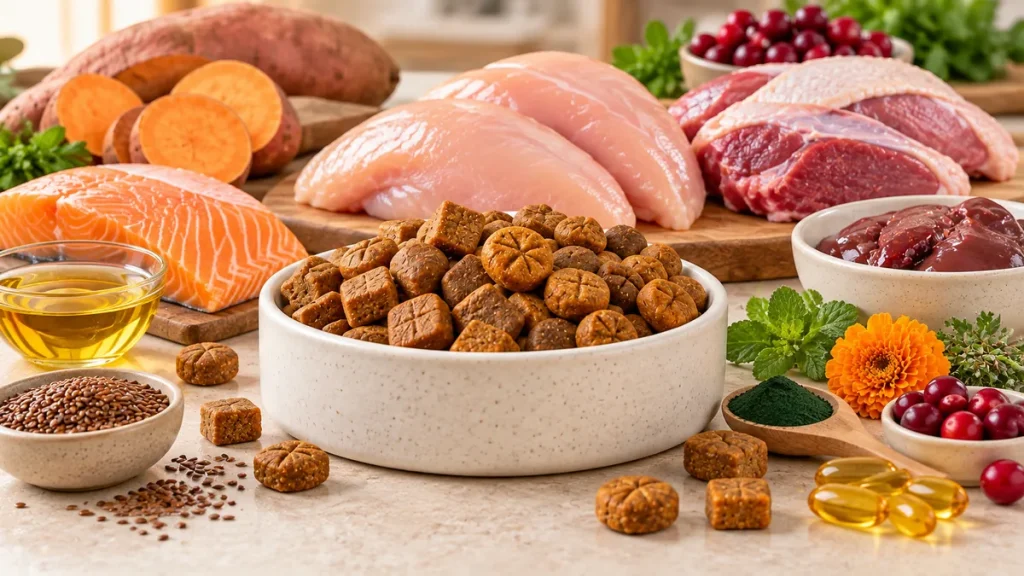
Production begins with formulation.
Depending on the target product, a recipe may include fresh meat, dehydrated animal proteins, fats and oils, carbohydrate sources, dietary fiber, vitamins, minerals, prebiotics, functional ingredients, and other approved pet food ingredients.
A premium formula should not be evaluated by a single headline ingredient alone.
Protein sources, amino acid balance, mineral ratios, energy density, processing losses, palatability, and the nutritional requirements of the intended species and life stage all need to be considered together.
For a complete diet, nutritional adequacy remains more important than whether the front of the package simply says “baked,” “fresh meat,” or “high protein.”
2. Mixing and Dough Preparation
The ingredients are weighed according to the formulation and mixed under controlled conditions.
Moisture is carefully managed because it affects forming, baking behavior, texture, and final product stability.
Fresh-meat formulas require particularly careful process control because raw materials can introduce additional moisture and create different handling requirements compared with formulas based mainly on dry ingredients.
3. Forming the Kibble
The prepared mixture is formed into the desired size and shape.
Kibble dimensions are more important than they may appear. Thickness and surface area can influence heating consistency, drying behavior, texture, and how easily a cat or dog can chew the finished food.
Manufacturers therefore need to match kibble design with the recipe and intended animal rather than treating shape as a purely cosmetic decision.
4. Controlled Baking
The formed pieces enter the baking system, where heat is applied under controlled conditions.
This is the defining stage of baked pet food production.
However, buyers should be cautious with broad claims such as “low temperature preserves all nutrients.” No commercial thermal process preserves every nutrient unchanged, and the actual effect depends on temperature, time, moisture, ingredient composition, equipment, and subsequent processing.
A more useful question is:
What validated process conditions does the manufacturer use, and how does it verify the finished product?
5. Cooling, Coating and Final Quality Control
After thermal processing, the food is cooled before packaging. Depending on the formula and production method, certain fats, palatants, or functional ingredients may be applied during or after the main thermal stage.
Finished-product controls may include measurements of moisture, water activity, nutrient composition, microbiological indicators, kibble consistency, and palatability.
This is where a credible manufacturing system becomes more important than the marketing term “baked.”
Low-Temperature Baked vs. Extruded Pet Food
Extrusion and baking can both be used to manufacture dry pet food, but they are different processing systems.
| Factor | Low-Temperature Baked Pet Food | Extruded Pet Food |
|---|---|---|
| Main process | Controlled baking | Extrusion using heat, moisture, pressure and mechanical shear |
| Kibble structure | Often denser and less expanded | Usually more expanded and porous |
| Processing | Longer controlled heating depending on system | Shorter high-intensity extrusion followed by drying |
| Formula flexibility | Can support fresh-meat and premium positioning | Extremely flexible and widely established |
| Production efficiency | Generally lower throughput | Highly efficient at large industrial scale |
| Texture | Often dense and crisp | Typically lighter and more expanded |
| Market positioning | Frequently premium | Mass market through premium |
Neither process should automatically be described as nutritionally superior.
Research comparing baked, pelleted, and extruded dog foods demonstrates that processing method can influence physical and nutritional characteristics, but the finished formula, processing parameters, and feeding performance all matter.
In other words, process is one variable—not the entire nutritional story.
What Are the Potential Benefits of Low-Temperature Baking?
Different Kibble Texture and Density
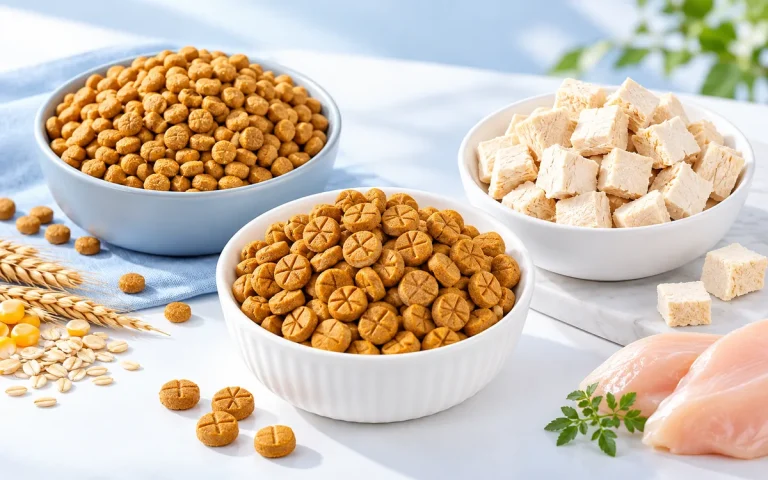
Baked kibble is generally less expanded than conventional extruded kibble.
This creates a different eating experience and gives brands another way to differentiate their products beyond flavor and packaging.
For premium product development, visible differences in kibble structure can also help communicate that the food is manufactured differently from conventional extruded products.
Greater Flexibility for Premium Formulation
Low-temperature baking can be used with formulas containing substantial animal-derived ingredients and fresh-meat components.
That makes the process particularly interesting for brands developing high-meat, limited-ingredient, grain-free, or functional formulations.
However, the actual percentage of fresh meat should always be verified from the formulation rather than assumed from the manufacturing process.
A Clear Premium Product Story
From a product-positioning perspective, “gently baked” or “low-temperature baked” is relatively easy for consumers to understand.
It provides brands with a manufacturing story that can be explained through packaging, educational content, product pages, and retail materials.
The strongest positioning, however, combines the process story with measurable information such as ingredient percentages, guaranteed analysis, nutritional adequacy, quality-control documentation, and laboratory testing.
Does Low-Temperature Baking Preserve More Nutrients?
This question needs a careful answer.
Heat can affect nutrients, but nutrient stability is influenced by far more than the maximum processing temperature. Exposure time, moisture, oxygen, ingredient matrix, storage, and the individual nutrient all matter.
For this reason, it is too simplistic to say:
“Lower temperature always means more nutrients.”
Pet food manufacturers account for processing effects during formulation and may adjust nutrient inclusion to ensure the finished product meets its intended nutritional specifications.
For buyers, finished-product verification is therefore more meaningful than comparing one processing temperature printed in a brochure.
Ask for information such as:
- Finished-product nutritional analysis
- Guaranteed analysis
- Nutritional adequacy documentation
- Raw-material specifications
- Batch quality-control procedures
- Microbiological testing
- Shelf-life and stability data
The finished food—not the marketing phrase—should support the nutritional claim.
Is Baked Pet Food Easier to Digest?
Digestibility cannot be determined solely by whether a food is baked or extruded.
Protein source, starch cooking, fiber level, fat content, ingredient quality, particle size, processing conditions, and the individual animal can all affect digestive response.
Scientific work comparing different dry pet food processing methods has shown that baking, pelleting, and extrusion can produce differences in food characteristics and nutrient utilization.
But this does not justify treating every baked food as more digestible than every extruded food.
Brands making specific digestibility claims should have appropriate evidence to support them.
Is Low-Temperature Baked Pet Food Complete and Balanced?
It can be—but the manufacturing process alone does not make a food nutritionally complete.
A complete pet food needs to supply required nutrients in appropriate amounts and ratios for its intended species and life stage.
For example, a manufacturer targeting the U.S. market may formulate a product to meet applicable AAFCO nutrient profiles or substantiate nutritional adequacy through an accepted feeding protocol.
European manufacturers and brands may refer to FEDIAF nutritional guidelines when developing complete foods for cats and dogs.
This distinction is important:
“Baked” describes how a food is processed. “Complete and balanced” describes its nutritional adequacy.
They are not interchangeable.
What Should Pet Food Buyers Check Before Choosing a Baked Formula?
For private-label brands, distributors, and importers, comparing baked products only by crude protein or fresh-meat percentage can lead to poor sourcing decisions.
A more complete evaluation should cover the following areas.
Actual Processing Parameters
Ask the manufacturer for the actual baking temperature range, processing duration, moisture-control approach, and cooling procedure.
Avoid relying on vague terms such as “gentle,” “slow cooked,” or “nutrient preserving” without supporting technical information.
Formula Transparency
Request the full ingredient composition and understand which percentages refer to fresh ingredients before processing and which refer to the finished product.
This is particularly important for fresh meat because fresh ingredients contain substantial moisture.
Nutritional Verification
Ask how the finished formula is evaluated.
Depending on your market and product claims, this may include laboratory nutrient analysis, guaranteed analysis, nutritional adequacy assessment, feeding tests, or other verification.
Food Safety and Quality Control

Review the manufacturer’s food-safety system, raw-material inspection procedures, batch traceability, microbiological controls, and relevant certifications.
A premium processing method cannot compensate for weak quality management.
OEM and Private-Label Capability
If you are developing your own brand, determine whether the manufacturer can adjust:
- Protein sources
- Fresh-meat percentage
- Protein and fat targets
- Functional ingredients
- Grain-free or grain-inclusive formulations
- Kibble size and shape
- Packaging format
- Label information for the destination market
This is especially important when the same product concept will be sold in multiple countries.
Common Mistakes When Evaluating Baked Pet Food
One of the most common mistakes is assuming that “baked” automatically means healthier.
It does not.
Another is comparing manufacturing temperatures without considering processing time, moisture, recipe composition, and finished-product analysis.
Buyers should also be careful with absolute claims such as “retains 100% of nutrients,” “completely prevents nutrient loss,” or “always more digestible than extruded food.” Statements like these require evidence and are rarely supported by processing method alone.
Finally, do not ignore nutritional adequacy.
A beautifully marketed baked formula still needs to provide appropriate nutrition for its intended species and life stage.
Low-Temperature Baked Pet Food for Private-Label Brands
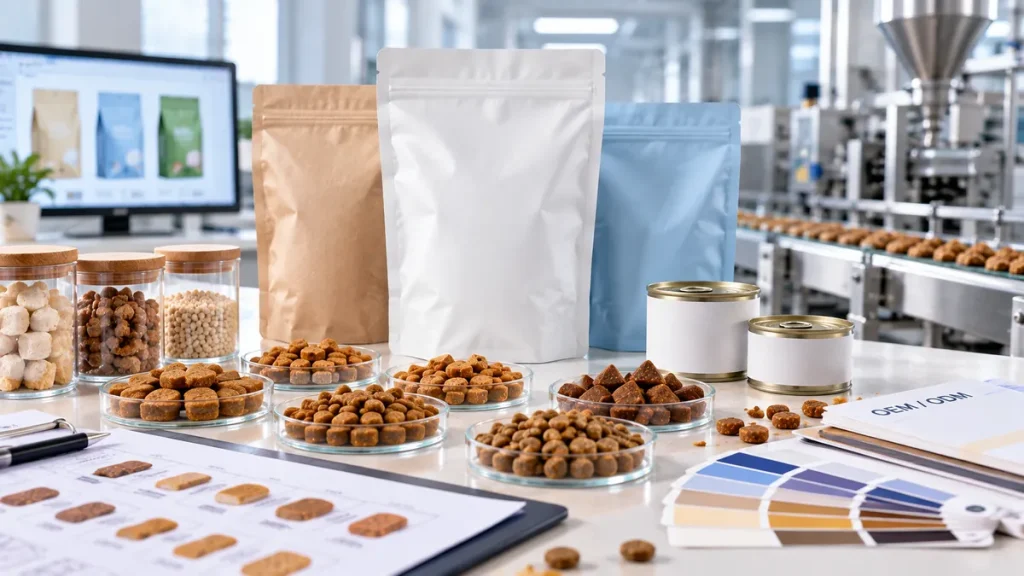
For brands developing premium dry pet food, low-temperature baking offers an interesting middle ground.
It retains the storage and distribution convenience of dry food while creating a product that can be differentiated through processing method, kibble texture, fresh-meat formulation, and premium positioning.
Hengsheng Pet Food produces low-temperature baked dog and cat food at its Foshan manufacturing facility and supports OEM/ODM development including formula adjustment, protein selection, kibble customization, packaging, and private-label production.
For buyers, the most productive starting point is not simply asking, “Can you make baked pet food?”
Instead, define:
- Target market
- Cat or dog
- Life stage
- Target protein and fat
- Preferred animal proteins
- Fresh-meat target
- Functional ingredients
- Target retail price
- Package size
- Regulatory destination
These requirements allow the manufacturer to determine whether an existing formula can be adapted or a new formula needs to be developed.
Frequently Asked Questions
What is low-temperature baked pet food?
Low-temperature baked pet food is dry cat or dog food manufactured using a controlled baking process instead of conventional extrusion. Exact temperatures and processing conditions vary by manufacturer.
Is baked pet food better than extruded pet food?
Not automatically. Both methods can produce nutritionally appropriate pet food. Formula design, ingredient quality, process control, nutritional adequacy, food safety, and finished-product testing are more important than the processing label alone.
Does low-temperature baking preserve nutrients?
Processing temperature can influence nutrient stability, but time, moisture, oxygen, ingredient composition, storage, and individual nutrient characteristics also matter. Finished-product nutritional analysis provides more useful evidence than temperature alone.
Can low-temperature baked food be complete and balanced?
Yes. A baked formula can be complete and balanced when it is appropriately formulated and substantiated for the intended species and life stage. Baking itself does not establish nutritional adequacy.
Can baked pet food be customized for private-label brands?
Yes. Depending on manufacturing capability, brands may customize protein sources, nutrient targets, functional ingredients, kibble characteristics, packaging, and other formula parameters.
Conclusion
Low-temperature baked pet food is more than a different-looking kibble. It represents an alternative dry-food manufacturing process that can support distinctive texture, formulation flexibility, and premium product positioning.
But buyers should look beyond the word “baked.”
The most reliable evaluation combines processing information, formula transparency, nutritional adequacy, finished-product testing, food-safety controls, and manufacturing capability.
For brands considering a baked product line, understanding these factors makes it easier to compare manufacturers, evaluate formulas, and develop a product that has both a strong market story and a sound nutritional foundation.