Pet Food Manufacturer - OEM/ODM & Private Label

Private Label Pet Food Packaging: Materials, Bag Sizes, Printing & MOQ Guide
A practical packaging guide for pet food brands, importers, distributors, and OEM/ODM buyers.
Your pet food formula is approved. The samples look right, and the manufacturer has confirmed that the product can be made at your expected order volume.
Now you need packaging.
You want a 2 kg printed bag with a zipper, a premium finish, and enough room for the required product information. Your designer has prepared the artwork, but the packaging supplier asks for the material structure, bag dimensions, printing specifications, and order quantity.
Suddenly, choosing a bag is no longer just a design decision.
For private label pet food brands, packaging affects product protection, cost, storage, shipping, labeling, and the purchasing commitments required before production.
This guide explains how to plan private label pet food packaging, from choosing materials and bag formats to approving artwork, understanding minimum order quantities, and preparing a practical packaging specification for your OEM manufacturer.
1. Start With the Pet Food Product, Not the Bag Design
Packaging should be selected for the product it will contain.
A dry kibble product, a freeze-dried treat, and a wet pet food each have different characteristics. They may require different barrier properties, sealing methods, filling equipment, and storage conditions.
Before discussing colors, logos, or finishes, establish five things:
- What type of pet food will be packed?
- How much product will each retail unit contain?
- What product characteristics must the packaging protect?
- Where will the product be shipped, stored, and sold?
- Which packaging formats can the manufacturing process accommodate?
These questions determine what is technically suitable.
A manufacturer may offer an attractive pouch, but that does not automatically make it appropriate for your formula or available on the required packaging line.
For example, a bag suitable for small dry kibble may need different dimensions when filled with a larger, less dense product. Even if both products weigh 2 kg, they may not occupy the same volume.
For brands developing dry products, Hengsheng’s OEM extruded adult dog food options provide an example of how formula, kibble characteristics, net weight, and private label packaging requirements need to be considered together.
The first packaging discussion should therefore include the product specification, not just a picture of the bag you like.
2. Compare Common Pet Food Packaging Formats
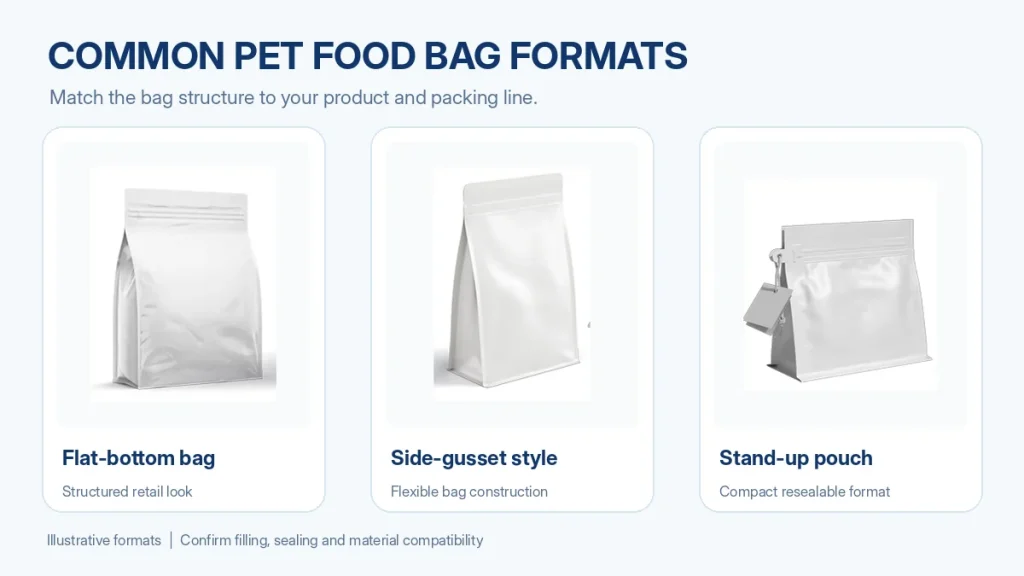
Pet food packaging comes in several forms. The best choice depends on the product, retail positioning, package size, and available manufacturing equipment.
The following are common packaging formats used in the industry. Their inclusion here does not mean that every format is available for every Hengsheng project.
| Packaging format | Typical applications | Main considerations |
|---|---|---|
| Flat-bottom bag | Retail dry pet food and premium products | Shelf presentation, base stability, filling compatibility |
| Stand-up pouch | Smaller packs, treats, selected dry products | Reseal features, base stability, available capacity |
| Side-gusset bag | Larger dry-food formats | Bag dimensions, handling, sealing, storage |
| Three-side-seal pouch | Samples and certain smaller products | Filling method, tear opening, sealing requirements |
| Can or rigid container | Certain wet foods | Appropriate filling, processing, closure, and container suitability |
| Retort pouch | Certain shelf-stable wet foods | Validated thermal process, seal integrity, material compatibility |
Flat-bottom bags
Flat-bottom bags are often chosen when brands want a structured retail appearance.
They can present printed artwork across several panels and may stand more securely on a shelf than some flexible alternatives.
However, this format is not automatically the best choice for every dry food.
The required dimensions, material structure, filling method, and acceptable cost still need to be evaluated.
Stand-up pouches
Stand-up pouches can be practical for smaller retail packs or treats.
Some designs support a resealable zipper or other opening features.
The brand should confirm how the pouch behaves after filling, whether its base is stable, and whether the opening and closure are suitable for the intended use.
A zipper improves convenience after opening, but it does not replace the original package seal or establish shelf life.
Side-gusset bags
Side-gusset bags are another option for dry pet food.
They can accommodate different capacities and are commonly considered for larger packages, depending on the product and available packing arrangements.
Before selecting one, confirm the filled bag dimensions and how it will be packed into shipping cartons.
Cans and retort pouches
Wet pet food needs separate packaging and process evaluation.
A can or retort pouch intended for a shelf-stable wet food must be compatible with the product and the validated manufacturing process. Container closure and processing requirements are critical.
Do not assume that a pouch used for dry treats can be adapted for wet food by simply changing the material.
For an OEM project, confirm whether the manufacturer has the appropriate product-processing and packaging arrangements before committing to a format.
Buyer checkpoint: Choose a packaging format only after confirming product compatibility, filling capability, closure requirements, and the intended distribution conditions.
3. Understand Pet Food Packaging Materials and Barrier Properties
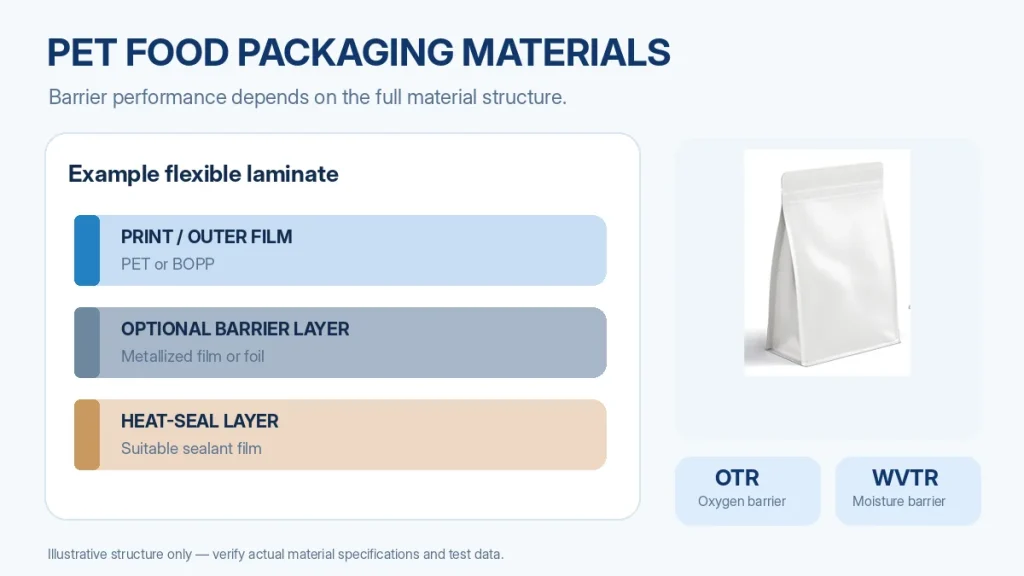
A packaging material should do more than look attractive.
Depending on the product, it may need to control moisture transfer, oxygen exposure, light, physical damage, or other factors that influence product quality.
The appropriate material depends on the food and the expected storage conditions.
Common flexible packaging structures
Flexible packages often use more than one material layer.
Different layers may contribute strength, printability, sealing performance, or barrier properties.
Examples of material components include:
| Material or component | Potential function | What buyers should verify |
|---|---|---|
| PET film | Print surface and mechanical properties | Grade, thickness, laminate structure |
| BOPP film | Printability and flexible-packaging structure | Complete laminate specification |
| PE sealant layer | Heat-sealing performance | Seal compatibility and product-contact suitability |
| Metallized film | Additional barrier characteristics in suitable structures | Actual oxygen and moisture barrier data |
| Aluminum foil layer | Strong barrier potential in an appropriate laminate | Pinholes, flex resistance, full-package performance |
| Mono-material structure | May support certain recycling design approaches | Functional performance and local recycling acceptance |
These descriptions are general. The performance of a finished bag depends on its complete construction, not just one material named in a quotation.
For example, two bags described as PET/PE may have different thicknesses, adhesives, coatings, sealing characteristics, and barrier performance.
Asking only whether a bag is “high barrier” is not enough.
Oxygen transmission rate (OTR)
OTR describes how oxygen passes through a packaging material under specified test conditions.
Oxygen exposure may matter for products containing fats and other oxidation-sensitive components.
The relevant barrier requirement depends on the formula, product characteristics, target shelf life, and storage environment.
Ask the packaging supplier for suitable test information rather than assuming a particular material is always superior.
Water vapor transmission rate (WVTR)
WVTR describes the rate of water vapor transmission under specified conditions.
Moisture control can be important for dry pet food and treats because changes in moisture may affect texture, product stability, or other quality characteristics.
The appropriate target should be established for the specific food, not copied from an unrelated product.
When comparing material proposals, request the actual test values and the conditions under which they were measured.
Does a thicker bag always offer better protection?
Not necessarily.
Thickness may influence strength and other properties, but it does not establish oxygen or moisture barrier performance on its own.
A thinner multilayer structure may perform differently from a thicker structure made from other materials.
The correct comparison is based on the finished package’s requirements and evidence.
What about recyclable packaging?
Sustainability claims need careful review.
A bag described as “recyclable” may still depend on local collection and recycling infrastructure, material composition, coatings, adhesives, and other factors.
A paper-looking pouch may also contain plastic or other barrier layers.
Do not use terms such as 100% recyclable, biodegradable, or compostable without suitable substantiation for the intended market.
Buyer checkpoint: Request the full material specification, relevant barrier data, sealing information, and evidence supporting any environmental claims.
4. Choose the Right Pet Food Bag Size and Dimensions
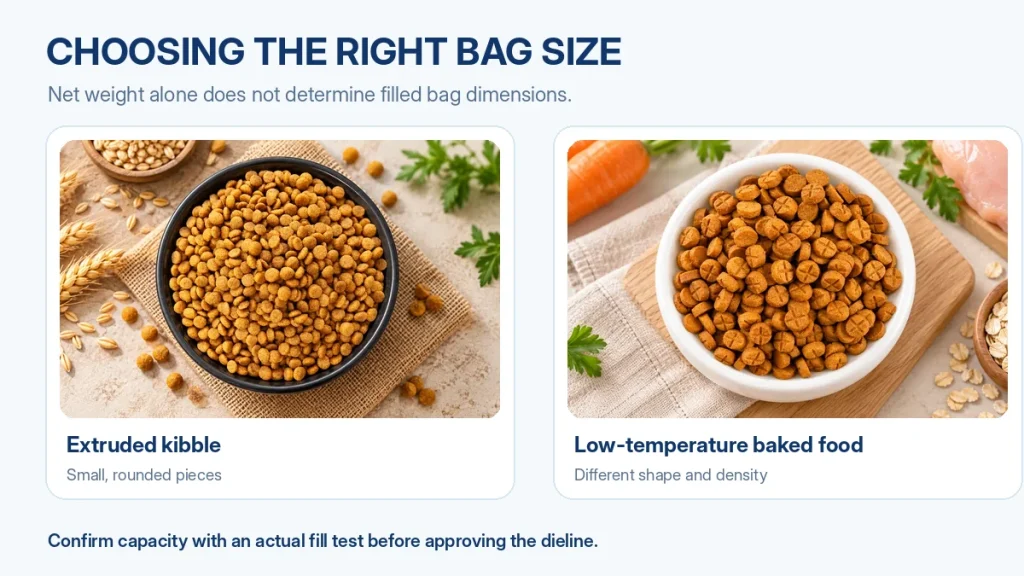
Net weight and bag dimensions are related, but they are not interchangeable.
A 2 kg bag specification tells you how much pet food should be inside. It does not tell you the bag’s required width, height, base, or usable filling volume.
This becomes important when comparing extruded kibble with baked food or other products of different shapes and densities.
Why the same weight may require different bags
Imagine two products that both need to be sold in 2 kg packs.
The first is a small, relatively dense kibble. The second uses larger or less densely packed pieces.
The products may occupy different volumes even at the same net weight.
As a result, using identical bag dimensions could leave one package underfilled in appearance or create filling difficulties for the other.
The correct dimensions should be established using the actual finished product.
When developing a baked product, reviewing the differences between low-temperature baked and extruded pet food can help clarify why physical kibble characteristics deserve attention during product planning.
What dimensions should you confirm?
For a flexible retail bag, the specification may need to identify:
- Finished width and height
- Bottom or side-gusset dimensions, if applicable
- Bag material and thickness
- Usable filling capacity
- Seal and closure positions
- Zipper location, if included
- Tear notch or opening features
- Print and finishing requirements
The packaging supplier should provide a suitable technical drawing or dieline.
A designer’s visual mockup is not a substitute for the actual bag dimensions.
Use a physical filling test
Before approving a commercial bag size, request a sample made to the proposed dimensions and fill it with the intended product.
Check whether the bag closes correctly, stands or stacks as expected, and has an acceptable appearance.
A mockup without food inside may look perfect but behave differently when filled.
If the product will be shipped in cartons, verify the final filled-pack dimensions rather than relying on the empty bag’s measurements.
Common retail weights
Private label dry pet food projects may involve smaller retail bags as well as larger formats, depending on the brand and customer requirements.
For example, Hengsheng’s extruded adult dog food product information lists customizable weights such as 2 kg, 10 kg, and 15 kg.
These are examples of product packaging specifications, not a promise that every formula and package combination is available under identical commercial terms.
Buyer checkpoint: Approve dimensions using the real product, the planned net weight, and the actual bag construction.
5. Plan Printing, Branding, and Artwork Requirements
Once the structure and dimensions are confirmed, the project can move into artwork preparation.
For a private label brand, packaging is a major part of the retail presentation.
However, attractive graphics should not hide the technical information needed for printing and production.
Standard bags with applied labels
A standard bag with a suitable custom label may be worth evaluating for a brand testing a new product.
This approach can reduce the need for a fully custom-printed packaging design, depending on material availability and the project.
It also creates its own requirements.
The label must remain suitable for the package surface, storage conditions, and applicable labeling rules.
Do not assume that applying a sticker automatically makes an otherwise incorrect package compliant.
Fully custom-printed packaging
A fully printed bag can provide greater control over artwork placement, brand consistency, and retail appearance.
However, custom printing may require specific material commitments, production setup, color approvals, and minimum quantities.
The printing method can influence costs and feasibility.
Depending on the packaging supplier, options may include conventional processes or digital printing for suitable applications.
Buyers should confirm which methods are actually available rather than assuming every supplier offers the same technology.
What should your designer prepare?
Ask the packaging supplier for the current dieline before starting the final design.
The artwork package may need to include:
- Correct finished dimensions and panel boundaries
- Bleed and safe areas
- Color specifications
- Required fonts or outlined text
- Print-ready image resolution
- Barcodes and their required placement
- Product information and legal text
- Finish requirements, such as matte or gloss effects
Some production methods may also require separate spot-color or technical layers.
The supplier should provide the exact artwork requirements for the proposed process.
Always approve a print proof
Screen colors can differ from printed results.
The buyer should check the approved color references, printed text, product images, barcodes, and layout before authorizing the full print run.
If physical color matching is important, discuss the available proofing method.
A digital preview is helpful for layout review but may not establish the final appearance of specialty finishes or printed materials.
Buyer checkpoint: Never authorize commercial printing solely because the artwork looks good on a computer screen.
6. Understand Pet Food Packaging MOQ Versus Manufacturing MOQ
This is one of the most important issues for private label pet food buyers.
The minimum quantity required to manufacture the food may differ from the quantity required to purchase its custom packaging.
These are separate commercial commitments.
A manufacturer may be able to produce the intended product quantity, while the packaging supplier requires a larger purchase of printed bags.
Hengsheng’s standard food production MOQs
At Hengsheng Pet Food, the current standard production starting quantities are:
| Product category | Standard production MOQ |
|---|---|
| Extruded pet food | 3,000 kg |
| Low-temperature baked pet food | 1,000 kg |
| Pet treats | 300 kg |
Final quantities depend on the formula, product specifications, packaging, and project arrangements.
These are food production MOQs, not guaranteed custom packaging MOQs.
Other product categories should be confirmed separately.
Our private label pet food MOQ guide explains how minimum production quantities affect quotation and first-order planning.
Calculate the number of retail bags
Suppose a buyer plans to order 3,000 kg of dry pet food in 2 kg bags.
The theoretical number of finished retail packs is:
3,000 kg ÷ 2 kg = 1,500 bags
This is only a planning calculation.
The actual packaging purchase may also need to account for filling and sealing losses, inspection rejects, samples, or an agreed spare quantity.
Ask the manufacturer and packaging supplier to establish the required packaging quantity based on the project.
What happens when packaging MOQ is higher?
Consider a case where the food order requires fewer bags than the packaging supplier’s minimum printed quantity.
The buyer should clarify:
- How many bags must be purchased?
- How many will be used in the first production run?
- Who owns the unused packaging?
- Where will it be stored?
- Are there storage fees or time limits?
- What happens if the formula or artwork changes before the next order?
Unused packaging is still inventory with a cost.
If the brand changes its design before the remaining bags are used, that inventory may become unusable.
Does each flavor need a separate packaging MOQ?
Not necessarily, but it cannot be assumed that different designs are combined into one packaging minimum.
A chicken formula and a salmon formula may use different printed artwork.
Even if the bag dimensions are identical, separate artwork can create separate printing or purchasing requirements.
Likewise, one formula sold in two net weights may need different bag dimensions and print files.
Ask the supplier to quote each combination clearly.
Buyer checkpoint: Request separate quantities and costs for pet food production, printed packaging, and each finished SKU.
7. Check Labeling Requirements Before Printing
Label artwork should be finalized only after the underlying product specification has been approved.
A design may be visually attractive but unsuitable for the intended market because important information is missing or a product claim is unsupported.
The destination market determines which requirements apply.
United States
The US FDA regulates animal food labeling under federal requirements, including 21 CFR Part 501.
Important federal labeling elements include product identity, net quantity, responsible business information, and ingredient statements.
Additional requirements can apply through individual state laws and other applicable rules.
AAFCO provides pet food labeling guidance and model regulations used by many states.
Before approval, brands should review both the FDA animal food labeling requirements and the AAFCO pet food labeling guidance.
Do not assume that an attractive front panel or a completed ingredient list covers every applicable requirement.
European Union
For the EU, Regulation (EC) No 767/2009 establishes requirements for placing feed on the market and its labeling.
The European Commission provides an overview of the EU feed marketing rules.
FEDIAF’s Code of Good Labelling Practice offers practical guidance for pet food labeling and communication.
The precise requirements depend on the product and the applicable legislation.
A label intended for another market should not be reused without reviewing its suitability for the EU.
Other international markets
For Southeast Asia, the Middle East, and other export destinations, buyers should confirm the requirements of the specific importing country.
These may involve local languages, importer information, permitted claims, product registration, or other relevant documentation.
There is no single packaging label that can be assumed to meet every country’s requirements.
Review claims carefully
Packaging may feature statements such as:
- Grain-free
- High protein
- Complete and balanced
- Hypoallergenic
- Supports skin and coat health
These claims should be evaluated against the actual product and applicable regulatory requirements.
For example, a complete and balanced statement requires an appropriate nutritional basis. A disease-related claim can raise additional regulatory concerns.
Do not add claims simply because they appear on competing products.
Confirm who signs off on the label
The manufacturer may provide formula details, technical specifications, and supporting product documentation.
However, the buyer, importer, and manufacturer should clearly agree on who is responsible for market-specific label review and final approval.
The approved artwork should have a clearly identified version.
Buyer checkpoint: Do not send files for commercial printing until the correct product information and market-specific requirements have been reviewed.
8. Test the Packaging Before Approving Mass Production
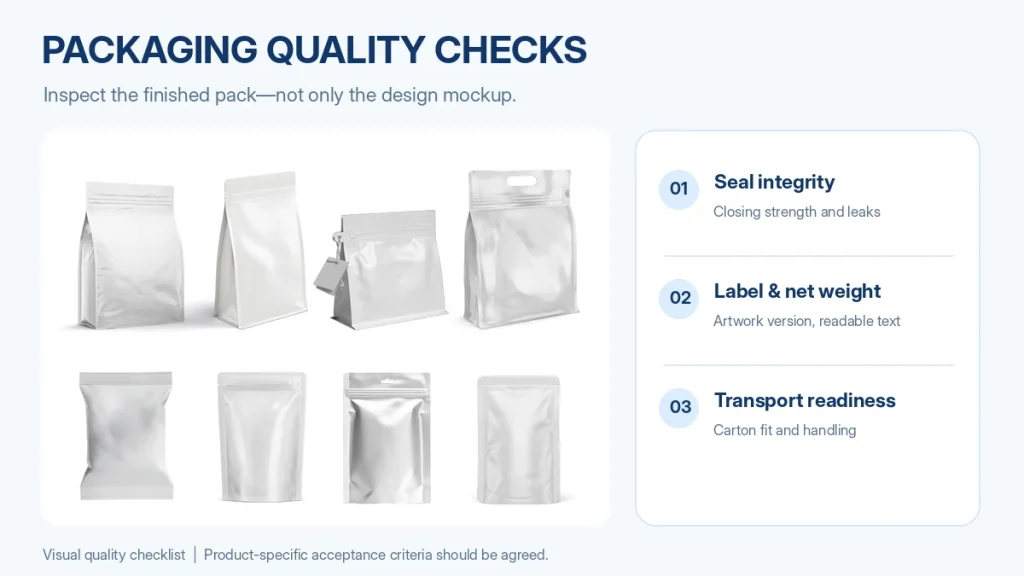
A bag that looks good when empty may behave differently after filling, sealing, shipping, and storage.
Packaging approval should therefore include appropriate physical and functional checks.
The exact tests depend on the material, product, and distribution conditions.
Seal integrity
The seal must perform as required for the product.
Ask the supplier how seal quality is evaluated and whether the selected packaging material is suitable for the intended filling equipment.
For bags with a zipper, distinguish between the factory seal and the consumer’s resealable closure.
The zipper is generally a convenience feature, not proof that the original pack is protected before opening.
Product and package compatibility
The chosen material should be evaluated for the actual food.
A dry product with a particular fat content, particle size, or moisture requirement may create different considerations from another formula.
For a new combination of formula and packaging, ask what evidence supports the intended shelf life.
A long shelf-life claim should not be inferred from the packaging material alone.
Shipping and handling
Assess whether filled packs can withstand the intended distribution process.
Relevant checks may include handling resistance, carton fit, seal performance, and damage observed during appropriate transport simulations or trials.
The purpose is to identify foreseeable issues before commercial shipment.
Printed artwork inspection
Before accepting printed packaging, review:
- Correct product and flavor
- Correct net weight
- Consistent colors and print registration
- Readable mandatory information
- Barcode legibility
- Correct bag dimensions and material
- Agreed finish and physical features
Pay special attention to net weight and formula details.
An incorrect weight declaration is not just a design mistake. It can create labeling and commercial problems.
What if the packaging changes after approval?
If the material, dimensions, artwork, or other important details change, determine whether a new approval is necessary.
Keep the final packaging specification and artwork revision connected to the approved production order.
For a broader view of version control and approval before manufacturing, see our OEM pet food sampling and production approval guide.
9. Compare Packaging Quotes on the Same Basis
Two packaging quotations may look similar while including different items.
One price may cover only empty printed bags. Another may include additional design preparation, delivery, or other services.
Before choosing an option, ask for an itemized quotation.
| Cost area | What buyers should clarify |
|---|---|
| Bag material | Full structure, dimensions, thickness, specification |
| Printing | Number of designs, colors, setup and proofing |
| Bag features | Zipper, tear notch, handle, special finish |
| MOQ | Minimum per size, design, and material |
| Sampling | Physical samples and proofing charges |
| Delivery | Packaging freight and destination |
| Storage | Ownership and handling of unused bags |
| Reorders | Minimum quantity and whether setup costs recur |
| Production fit | Any additional filling or sealing requirements |
Compare quotations using the same specification.
A cheaper bag may not be cheaper if it provides unsuitable performance or creates additional handling costs.
Conversely, a more elaborate package may add cost without delivering a meaningful benefit for the intended product or retail market.
Consider inventory risk
Custom printed packaging is often specific to one product, formula, size, and market.
Unused printed bags cannot always be transferred to another SKU.
If you are launching a new brand, consider whether the proposed packaging quantity fits your expected sales and repeat-order schedule.
The commercial objective is not simply to buy the lowest-priced bag. It is to choose a suitable package with a manageable total cost and inventory commitment.
10. Use a Written Packaging Specification for OEM Orders
A clear packaging specification helps prevent avoidable misunderstandings between the brand, packaging supplier, and food manufacturer.
It should establish the details required for quotation, sample approval, and commercial production.
Here is a practical example of the information to provide.
| Packaging requirement | Example or information needed |
|---|---|
| Product | Extruded dry dog food |
| Retail weight | 2 kg |
| Intended market | Specify country or region |
| Bag format | Proposed flat-bottom bag |
| Material | To be confirmed based on product requirements |
| Bag dimensions | Confirmed using actual product filling test |
| Closure | Zipper requested, subject to compatibility |
| Artwork | Approved print-ready file and version |
| Barcode | Brand-supplied code for the intended SKU |
| Label text | Reviewed for the destination market |
| First food order | 3,000 kg |
| Packaging quantity | Quoted separately for the agreed design |
| Outer cartons | Quantity per carton and shipping arrangement |
| Testing | Agreed seal, material, and package checks |
| Approval | Named person responsible for final sign-off |
This is an illustrative buyer brief, not a confirmed quotation or a guarantee of availability for a particular packaging type.
The supplier should review it and identify any technical or commercial issues before the brand authorizes production.
11. Discuss Private Label Packaging With Hengsheng Pet Food
Hengsheng Pet Food (Guangdong) Co., Ltd. is a pet food manufacturer based in Foshan, Guangdong, China.
Our approximately 5,000 m² manufacturing facility supports pet food OEM/ODM projects for overseas brand owners, distributors, and importers.
We can discuss private label packaging requirements alongside product formulation, production planning, and order quantities.
For dry-food projects, buyers can request a review of their intended retail weight, packaging design, formula requirements, and expected order volume.
The available packaging options, procurement quantities, printing arrangements, and final specifications need to be confirmed for each project.
If you are still comparing manufacturing partners, you can also review our pet food manufacturer selection checklist and company manufacturing background.
What should you send us?
To make the first packaging discussion useful, please share:
- Product type and intended formula
- Target retail weight
- Preferred bag format or reference image
- Proposed packaging material, if already specified
- Destination market
- Number of formulas and packaging designs
- Expected first-order quantity
- Available artwork or dieline
- Any special technical or labeling requirements
If you have not finalized the packaging design, identify the requirements you already know.
We can review your proposed product and discuss the next steps without assuming that every packaging format follows the same MOQ or production arrangement.
Frequently Asked Questions About Private Label Pet Food Packaging
What is the best packaging material for dry pet food?
There is no universally best material. The selection depends on the product’s moisture sensitivity, oxidation risk, intended shelf life, filling conditions, and distribution environment. Compare complete material structures and relevant performance data.
Can I customize pet food bags with my own brand?
Many OEM and private label projects use custom branding and packaging. Available formats, printing arrangements, and minimum quantities should be confirmed with the manufacturer and packaging supplier.
What is the difference between a flat-bottom bag and a stand-up pouch?
Both can provide retail presentation for suitable products. They differ in construction, shape, filling behavior, and potentially the available dimensions and features. Choose according to the actual product and packaging requirements.
Does the pet food manufacturing MOQ include printed bags?
Not necessarily. Food manufacturing and packaging procurement can have different minimum quantities. Request separate confirmation of the minimum food order, packaging purchase, and requirements for each design.
Can different flavors share the same packaging MOQ?
It depends on the packaging specification and supplier arrangements. Different printed artwork or bag sizes may require separate minimum quantities even if the general packaging format is the same.
Can I use the same bag dimensions for extruded and baked pet food?
Possibly, but do not assume the bags will fill identically. Different kibble structures and bulk densities can affect volume. A physical filling test is the safest way to evaluate the proposed dimensions.
Do printed pet food bags need special testing?
Testing should match the product and packaging risks. Depending on the project, relevant checks may include barrier properties, seal integrity, material suitability, physical handling, and shelf-life performance.
Can I use the same pet food label in the US and EU?
Not without reviewing the applicable requirements. The US and EU have different pet food labeling frameworks. Other markets may also have their own language, importer, and product information rules.
How should I request a packaging quotation?
Provide the product category, intended market, net weight, preferred bag format, estimated quantities, number of artwork versions, material requirements, and any available technical drawings. Ask for an itemized quotation identifying what is included.
Final Checklist Before Ordering Custom Pet Food Packaging
Before approving production, confirm that:
| Checkpoint | Status |
|---|---|
| Product type and formulation are confirmed | Yes / No |
| Bag material and structure are specified | Yes / No |
| Barrier requirements have been reviewed | Yes / No |
| Net weight and bag dimensions are confirmed | Yes / No |
| Physical filling compatibility has been evaluated | Yes / No |
| Printing method and artwork requirements are clear | Yes / No |
| Market-specific label review is complete | Yes / No |
| Packaging MOQ is confirmed separately from food MOQ | Yes / No |
| Unused printed packaging arrangements are agreed | Yes / No |
| Final approved artwork version is recorded | Yes / No |
| Relevant quality and sealing checks are established | Yes / No |
| Packaging delivery and production schedules are aligned | Yes / No |
A packaging order should not depend on assumptions that have not been discussed with the supplier.
The more important the requirement, the more important it is to document it before production begins.
Conclusion: Choose Packaging That Works Beyond the Shelf
Private label pet food packaging has two jobs.
It should present the brand clearly, and it should be technically suitable for the food inside.
A professional design cannot compensate for an unsuitable material, incorrect dimensions, weak sealing, or a label that does not meet the intended market’s requirements.
Before approving printed bags, confirm the complete packaging specification, test the intended product in the proposed format, and understand the separate purchasing commitments for food and packaging.
These decisions will help you build a product that is easier to manufacture, manage, and distribute.
Request a Private Label Pet Food Packaging Consultation
Planning custom packaging for a dry pet food or treat project?
Contact Hengsheng Pet Food with your product requirements, preferred retail weight, packaging references, destination market, and expected order volume.
Our team can review the proposed project and discuss suitable manufacturing and packaging arrangements.
Hengsheng Pet Food (Guangdong) Co., Ltd.
Telephone: +86-15322270596
WhatsApp: +86-182-3011-9927
Email: info@hengshengpet.com
Website: https://hengshengpet.com/