Pet Food Manufacturer - OEM/ODM & Private Label

OEM Pet Food Sampling Process: From Formula Brief to Mass Production
A practical guide to requesting, evaluating, and approving private label pet food samples before placing a commercial order.
You receive two pet food samples from a potential manufacturer. Both look similar, and both appear to match your target product. One has the texture you prefer. The other comes with a more attractive quotation.
Which one should you approve?
The answer depends on more than appearance or price.
A sample can show what a product looks, smells, and feels like. It cannot, on its own, confirm that the formula is nutritionally appropriate, that every production batch will meet the same specifications, or that the packaging will perform as expected during distribution.
For pet food brands and importers, sampling should be a controlled development and approval process—not just an exchange of product bags.
This guide explains the OEM pet food sampling process, from preparing a product brief and requesting samples to evaluating test results, confirming packaging, and approving commercial production.
It also outlines what buyers should ask a manufacturer before paying for development or committing to a first order.
What Is the OEM Pet Food Sampling Process?
The OEM pet food sampling process is the series of steps used to develop or select a pet food product, evaluate its characteristics, document agreed requirements, and determine whether it is ready for commercial manufacturing.
The process may be relatively simple when a brand chooses an existing formula with limited customization.
A new product with specific nutritional targets, ingredients, kibble characteristics, or packaging requirements generally needs more development work.
A practical project follows this sequence:
| Stage | Main objective | Expected decision or record |
|---|---|---|
| 1. Product brief | Define what the brand needs | Initial product requirements |
| 2. Feasibility review | Confirm what the factory can manufacture | Development scope and quotation basis |
| 3. Sample preparation | Produce or select a suitable reference | Identified sample version |
| 4. Buyer evaluation | Review product characteristics | Approval or revision feedback |
| 5. Technical review | Evaluate nutrition, safety, and specifications | Supporting test results and requirements |
| 6. Packaging approval | Finalize pack and artwork | Approved packaging specifications |
| 7. Production approval | Confirm the commercial product and order | Final agreed product specification |
| 8. First production review | Check conformity of the commercial batch | Batch records and agreed release evidence |
These are recommended project stages rather than a fixed procedure that every manufacturer follows identically.
A good supplier should explain which steps apply to your product and what must be confirmed before manufacturing begins.
1. Prepare a Clear Product Brief Before Requesting Samples
Sampling problems often begin with incomplete instructions.
A buyer may request a “high-protein premium cat food” without specifying the intended life stage, formula preferences, destination market, or finished-product requirements.
The manufacturer then has to make assumptions.
Those assumptions may produce an attractive sample that is not commercially suitable for the brand.
What should your product brief include?
Provide the following information wherever possible:
- Product type: extruded dry food, low-temperature baked food, wet food, or treats
- Species and life stage: for example, adult cats or adult dogs
- Nutritional purpose: complete diet, complementary product, or treat
- Formula preferences: animal proteins, ingredient restrictions, and nutritional targets
- Physical characteristics: preferred kibble shape, size, texture, or treat dimensions
- Target market: country or region where the product will be sold
- Retail packaging: intended net weight, material, and customization requirements
- Expected volume: first order and estimated repeat orders
Your brief should distinguish between requirements that cannot change and preferences that can be adjusted.
For example, a brand may require a particular protein source but accept some flexibility in kibble shape. Another brand may have strict product dimensions because its packaging and marketing photography are already finalized.
These differences affect the development process.
If you have not yet selected a supplier, our pet food manufacturer selection checklist explains how to evaluate manufacturing capabilities and supplier documentation before starting an OEM/ODM project.
2. Decide Which Type of Pet Food Sample You Need
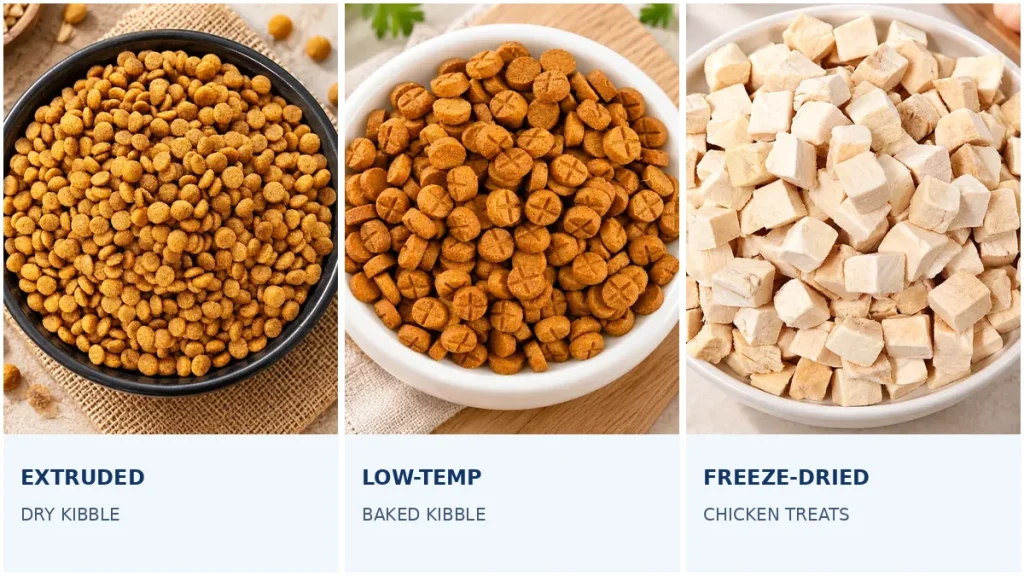
Not all samples serve the same purpose.
Before requesting one, ask the manufacturer what the sample represents and which decisions it is intended to support.
Existing formula sample
An existing formula sample allows buyers to examine a product that the manufacturer already offers or has experience producing.
This can be useful when the brand is open to using a mature formula with limited customization.
However, receiving an existing sample does not mean every ingredient, nutritional value, or packaging format can be changed without additional development.
Ask whether the sample is representative of an established commercial formula and what customization options are technically available.
Custom formulation sample
A custom formulation sample is prepared to evaluate specific development requirements.
These may involve changes to protein sources, nutritional targets, ingredient restrictions, or physical product characteristics.
Custom development can require additional work, raw materials, testing, or processing adjustments.
The manufacturer should clarify the development scope, expected costs, and any technical limitations before proceeding.
Packaging sample or mockup
A packaging sample serves a different purpose.
It may help you examine bag dimensions, material appearance, printing, or the overall presentation of your retail product.
An empty packaging mockup cannot demonstrate the shelf-life performance of the finished food inside that package.
Likewise, an attractive printed bag does not establish that the final label meets your destination market’s requirements.
Production reference sample
Once the product is finalized, an agreed reference sample may be used alongside the written specification to assess particular physical or sensory characteristics of subsequent production.
The reference should be identifiable and stored under appropriate conditions.
It is a supporting comparison tool, not a replacement for documented product requirements or testing.
Buyer checkpoint: Confirm whether the sample is an existing product, a development version, a packaging mockup, or a production reference. Do not treat them as interchangeable.
3. Check Whether the Formula Fits the Manufacturing Process
A recipe that works under one production method may need adjustments for another.
Processing can affect product structure, moisture, texture, appearance, and finished-product characteristics.
That is why a manufacturer should review technical feasibility before promising that a requested formula can be produced exactly as proposed.
Extruded dry pet food
In extrusion, ingredient composition and processing conditions influence how kibble forms and expands.
A brand requesting a particular size or texture may need to discuss moisture, density, forming conditions, and finishing requirements with the factory.
For buyers developing conventional dry dog food, Hengsheng’s OEM extruded adult dog food page provides a starting reference for product specifications and customization discussions.
The actual formula and characteristics still need separate approval.
Low-temperature baked pet food
Baked food uses a different manufacturing process.
Buyers may prefer a particular shape, density, or texture, but those features must be evaluated against the intended formulation and processing conditions.
Do not assume that a product made with lower processing temperatures is automatically more nutritious.
A meaningful comparison needs to consider the finished product, not just the temperature described in marketing materials.
For more information, read our guide to low-temperature baked pet food manufacturing.
Treats and other formats
Treats may involve different cutting, forming, baking, drying, or freeze-drying processes.
Wet food and other formats may require their own product development and packaging checks.
Ask the manufacturer to confirm the applicable process for your intended product before approving a sample.
The goal of technical feasibility review is to identify what can be manufactured consistently—not simply what can be made once in a small sample.
4. Evaluate Pet Food Samples With a Consistent Checklist
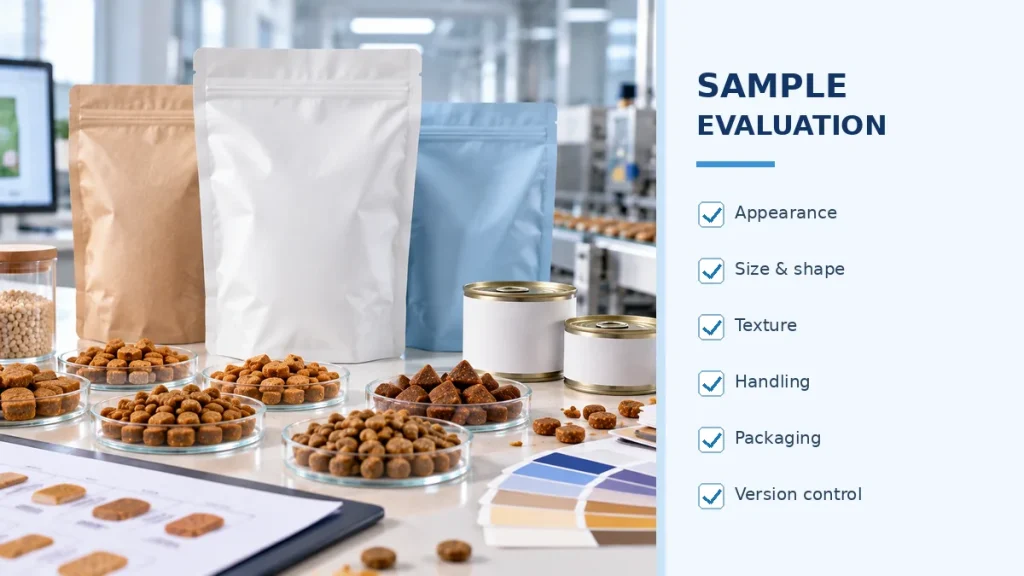
When a sample arrives, it is tempting to make a quick decision based on appearance and smell.
Those observations are useful, but they should be recorded consistently so the manufacturer can understand your feedback.
If you are comparing multiple factories or development versions, evaluate them against the same product brief.
What should you inspect?
| Evaluation item | What to check | Why it matters |
|---|---|---|
| Identification | Sample code, formula version, preparation date where available | Prevents confusion between versions |
| Appearance | Color, uniformity, visible defects | Establishes visual expectations |
| Size and shape | Kibble dimensions or treat-piece variation | Helps define physical specifications |
| Texture | Hardness, brittleness, structure | Influences handling and product positioning |
| Aroma | General sensory consistency | Helps compare development versions |
| Handling | Breakage, crumbs, visible oil, dust | May affect packaging and customer experience |
| Packaging | Seal, labeling, damage during transport | Identifies packaging and shipping concerns |
| Documentation | Formula summary, product specification, available test data | Supports technical evaluation |
A sample may satisfy your visual requirements but still need additional nutritional or safety assessment.
Keep these evaluations separate.
Avoid judging a product from one observation
An unusually dark kibble or a small difference in size does not automatically mean the product is defective.
The question is whether the result falls within the agreed product specifications.
Likewise, a sample that looks good in a photograph may behave differently after transportation or storage.
For products likely to experience long shipping routes, consider whether the approved packaging and product characteristics have been evaluated under relevant storage and distribution conditions.
If a formal shelf-life study or transport assessment is needed, agree on the scope rather than assuming that a short sample review provides the answer.
5. Record Sample Feedback So the Next Version Improves
A common source of delays is vague feedback.
Comments such as “make it more premium,” “the kibble should be better,” or “please improve the formula” leave too much room for interpretation.
Instead, identify the sample version, describe the issue, and explain the requested change.
For example:
| Unclear feedback | More useful feedback |
|---|---|
| The kibble is too big. | Please review a smaller kibble diameter suitable for our target product. |
| The color is not right. | The sample is darker than our approved visual reference; please investigate the cause and discuss feasible adjustments. |
| We want a better recipe. | Please review the proposed animal protein sources and the agreed nutritional targets. |
| The bag looks cheap. | Please compare the approved bag structure with an alternative finish and provide material specifications. |
Do not assume every requested change is technically possible or commercially neutral.
A modification to the formula may affect the processing conditions, nutritional profile, ingredient cost, or finished-product characteristics.
The factory should explain these implications before preparing another version.
Use version numbers
If you receive several development samples, keep their identities clear.
A simple system such as CAT-ADULT-V01, CAT-ADULT-V02, and CAT-ADULT-V03 can help organize approvals.
The exact naming method does not matter as much as keeping the sample, feedback, and related documents connected to the same version.
When a new sample replaces an earlier version, record what changed.
Otherwise, a buyer may accidentally approve the appearance of one version and the formula of another.
6. Review Nutrition, Quality, and Testing Requirements Separately
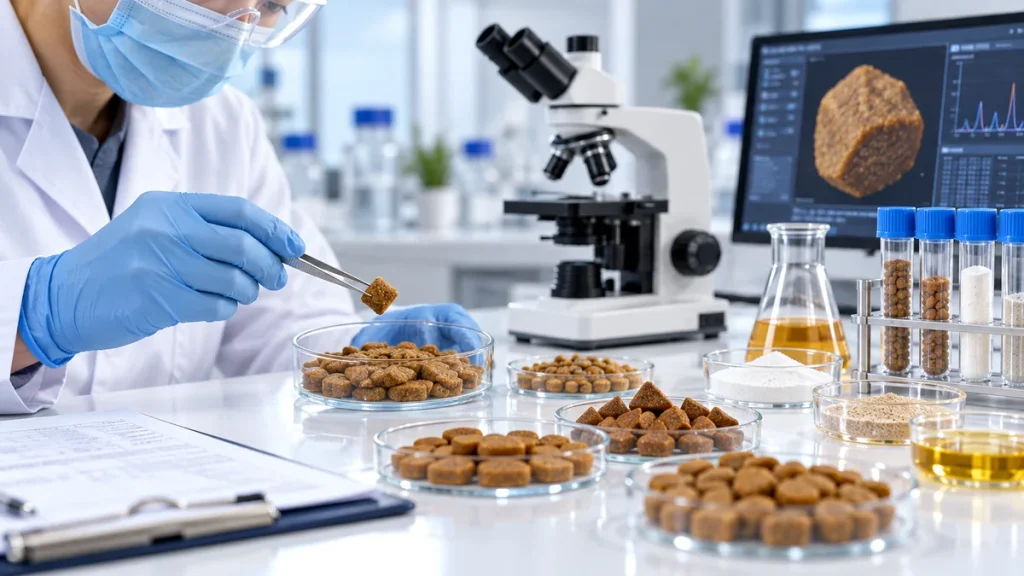
Sample evaluation should not rely entirely on sensory observations.
If the product is intended to be a complete diet, its nutritional suitability must be assessed for the intended species and life stage.
For products destined for Europe, the FEDIAF Nutritional Guidelines provide a reference for formulating and evaluating complete and complementary dog and cat food.
In the United States, the AAFCO pet food labeling guidance explains the recognized approaches to nutritional adequacy statements and related labeling requirements.
Neither reference means that a manufacturer can describe every sample as an approved complete diet without supporting evidence.
What testing may be relevant?
Depending on the product and agreed specifications, the review may involve:
- Nutritional composition and guaranteed-analysis considerations
- Moisture or water activity where relevant
- Microbiological requirements
- Applicable contaminant testing
- Physical product characteristics
- Packaging performance
- Appropriate shelf-life evaluation
The required tests, methods, and acceptance limits depend on the product and destination market.
Buyers should also clarify whether testing is performed on a development sample, a pilot or trial batch, or a commercial production batch.
Results from one version cannot automatically be transferred to a materially different formula.
What does a Certificate of Analysis establish?
A Certificate of Analysis, or COA, should be read in the context of the sample or batch it identifies.
Ask which product, lot, test methods, and results the document covers.
A COA from an earlier formulation should not be treated as evidence for a revised product without an appropriate technical basis.
For US-regulated facilities subject to the relevant rule, the FDA’s Preventive Controls for Animal Food requirements describe food safety planning, hazard controls, monitoring, and verification.
These regulatory requirements are distinct from an individual buyer’s sensory sample approval.
Buyer checkpoint: Agree on which tests and documents are necessary before production, who arranges them, and when results must be available.
7. Confirm Sample Costs, Courier Charges, and Shipping Arrangements
Sampling is part of product development, and its cost structure can vary.
Some manufacturers may have existing samples available. Others may need to purchase special ingredients or prepare a dedicated development batch.
Do not assume that all samples are free or that custom formulation work is included in a future production order.
Before dispatch, clarify:
- Whether the requested sample is already available
- Any sample or development fee
- International courier charges
- Who is responsible for destination-side duties or clearance costs
- Whether additional testing is included
- What happens if another sample revision is needed
- Whether any sample fees are creditable against a later order
If payment is required, request a clear pro forma invoice or other agreed payment document.
Can pet food samples be shipped internationally?
Shipment requirements depend on the destination country, ingredients, product classification, and applicable import rules.
Animal-origin products may face additional controls.
A small sample shipment is not automatically exempt from import restrictions simply because it is not being sold.
Before dispatch, confirm the recipient’s address and the import documentation needed for the particular product.
The buyer and manufacturer should also agree on the courier arrangement and responsibilities if the shipment is delayed, held, or returned.
8. Approve the Final Product Specification, Not Just the Sample
This is one of the most important stages in the OEM pet food sampling process.
A buyer may approve a sample in a chat message and assume the manufacturer now knows exactly what to produce.
That creates unnecessary ambiguity.
The final approval should connect an identified sample to an agreed written product specification.
The specification should establish the requirements that matter for commercial manufacturing.
What should be included?
For a dry pet food project, relevant items may include:
| Specification area | Information to confirm |
|---|---|
| Product identity | Formula name, version, product category |
| Intended use | Species, life stage, complete food or treat |
| Formula | Agreed composition and approved substitutions |
| Nutritional profile | Applicable nutrient targets and acceptance criteria |
| Physical characteristics | Kibble size, appearance, texture, moisture |
| Safety and quality | Relevant test methods and acceptance limits |
| Packaging | Material, net weight, dimensions, sealing requirements |
| Labeling | Final artwork version and approval responsibilities |
| Shelf life | Required evaluation and agreed storage conditions |
| Batch identification | Lot coding and traceability expectations |
The document should reflect the characteristics appropriate to the actual product. It does not need unnecessary technical detail that serves no purpose.
Who approves the final specification?
Identify the person or department authorized to approve the formula, packaging, and commercial terms.
Written approval is particularly valuable when the brand, purchasing agent, and factory each have different contacts.
Also agree on a process for handling later changes.
If an ingredient is replaced or the packaging material changes, the parties should determine whether additional evaluation and approval are required.
An approved sample is a useful reference. The written specification is what makes the production expectations clear.
9. Finish Packaging Approval Before Commercial Production
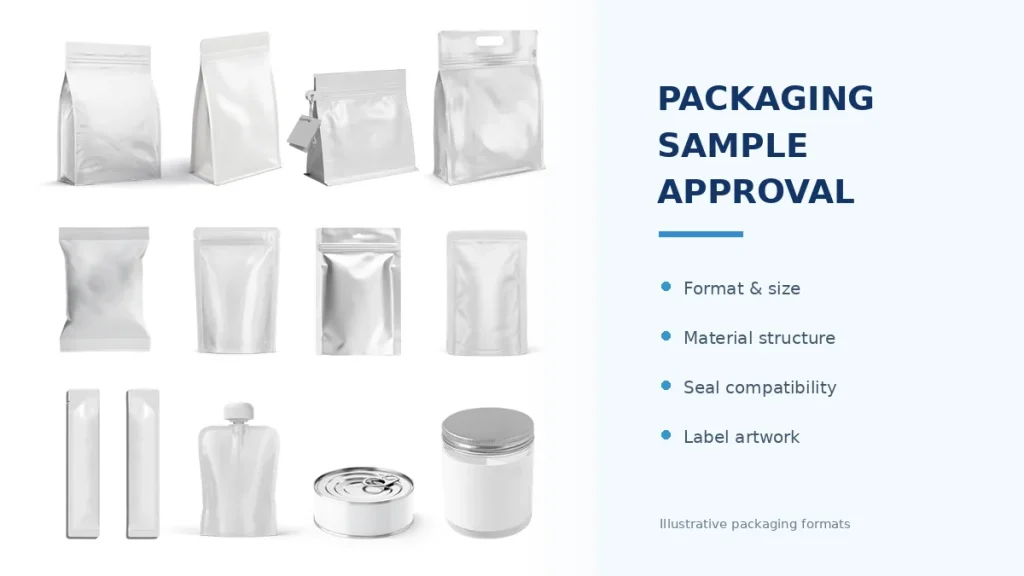
Packaging development often runs alongside formula sampling.
That can save time, but it also creates a risk: artwork may be printed before the product details are final.
A formula revision can affect ingredient declarations, nutritional information, feeding guidance, or claims.
For this reason, final packaging approval should follow the relevant product and regulatory review.
Check both the physical package and the artwork
The packaging review should address two different questions.
First, is the packaging technically suitable for the product?
Relevant considerations may include the material structure, barrier properties, seal integrity, dimensions, and expected distribution conditions.
Second, is the artwork ready for the intended market?
Review the product identity, ingredient information, nutritional statements, net weight, feeding directions, business details, and any other applicable label requirements.
The brand owner or importer should make sure the appropriate party has completed the market-specific review.
Packaging MOQ can differ from food MOQ
A manufacturer may be able to produce the requested pet food quantity while the printed packaging supplier requires a different minimum purchase quantity.
That can leave unused bags or increase the cost of a small first order.
Before confirming artwork, compare packaging commitments with the expected manufacturing volume.
Our private label pet food MOQ guide explains how production quantities and packaging decisions affect order planning.
Buyer checkpoint: Confirm formula, nutritional information, packaging structure, artwork version, and commercial quantity before authorizing printed materials or production.
10. Understand the Difference Between Sample Approval and Mass Production
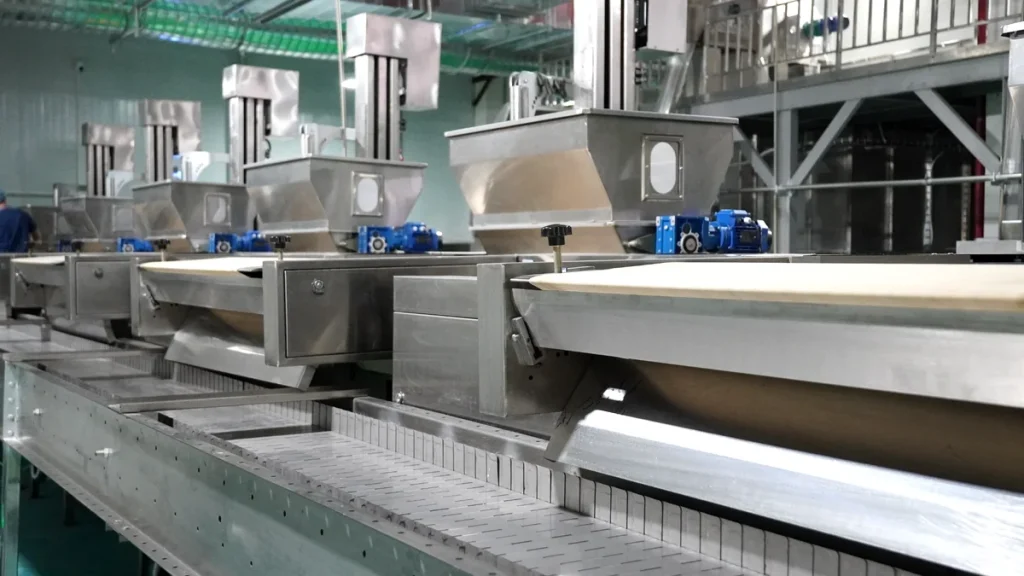
Approving a development sample does not automatically mean production can begin immediately.
The factory still needs to confirm the commercial order, availability of ingredients and packaging, production schedule, agreed testing requirements, and any necessary approvals.
The manufacturer should explain when the production lead time starts.
For example, it may depend on final specifications, packaging readiness, payment arrangements, or an agreed scheduling milestone.
Should you request a production trial?
For a new or technically demanding product, a trial or pilot production assessment may help identify scale-up issues.
However, not every project requires or can accommodate a separate pilot run.
Availability, cost, minimum batch size, and the intended evaluation scope must be discussed with the factory.
Do not assume that a small development sample was produced under identical conditions to a commercial batch.
How can you evaluate the first commercial batch?
Before production, agree on what evidence is needed for release.
Depending on the product and contract, this may involve:
- Batch identification and traceability records
- In-process inspection results
- Finished-product testing and COA where applicable
- Packaging and label checks
- Comparison with approved physical characteristics
- Handling of nonconforming results
The buyer should know who makes the release decision and what happens if the finished product does not meet an agreed criterion.
This is particularly important for the first order because the commercial production process may reveal issues that were not apparent during sample development.
11. Plan the First OEM/ODM Order Around Your Approved Formula
Once the sample and specifications are approved, the project moves from development to commercial planning.
At this stage, buyers should confirm the minimum order quantity for the relevant product category and formula.
At Hengsheng Pet Food, the current standard production MOQs are:
| Product category | Standard production MOQ |
|---|---|
| Extruded pet food | 3,000 kg (3 metric tons) |
| Low-temperature baked pet food | 1,000 kg (1 metric ton) |
| Pet treats | 300 kg |
Final requirements depend on the formula, packaging, and project specifications. Other product categories must be confirmed separately.
Do not assume that different recipes can be combined to reach a production minimum.
If your brand plans to launch three flavors, ask whether each formula needs a separate production quantity.
Build a realistic order schedule
A practical first-order schedule should distinguish among sample development, technical approval, packaging procurement, manufacturing, quality review, and shipment preparation.
These stages do not always happen consecutively.
Some packaging work may begin while samples are being evaluated, but final printing should not proceed until the relevant details are approved.
Rather than asking only “How many days is production?”, ask which milestones must be completed before the production date can be confirmed.
12. How Hengsheng Pet Food Supports OEM/ODM Project Discussions
Hengsheng Pet Food (Guangdong) Co., Ltd. is a pet food manufacturer based in Foshan, Guangdong, China.
Our approximately 5,000 m² facility supports pet food manufacturing and OEM/ODM project discussions for international brand owners, distributors, and importers.
Depending on the product and technical feasibility, buyers can discuss formula requirements, extruded or baked dry-food options, treats, packaging, production quantities, and relevant quality documentation.
Hengsheng’s existing management system documentation includes ISO 9001:2015 and ISO 22000:2018 certificates covering the activities specified in their respective scopes. Product-specific and destination-market requirements must be assessed separately.
You can review our factory background and manufacturing capabilities before requesting a product discussion.
For sample requests, the most useful starting point is a clear product brief.
Please share the intended product, destination market, formula expectations, packaging requirements, and estimated first order.
Our team can then review the proposed project, discuss the available development or sampling arrangement, and clarify any applicable fees, documentation, or minimum quantities.
Sample availability, customized development, and production arrangements are confirmed individually rather than promised on a universal schedule.
Frequently Asked Questions About OEM Pet Food Samples
Can I request pet food samples before placing a bulk order?
You can contact a manufacturer to discuss available samples and development options before committing to commercial production. Availability, fees, shipping arrangements, and technical requirements should be confirmed for the proposed product.
What is the difference between an existing sample and a custom pet food sample?
An existing sample represents an available product or formula direction. A custom sample is developed or adjusted for specified requirements. Customization may involve additional materials, technical work, and testing.
How many sample revisions are needed?
There is no universal number. Some projects may require limited changes, while more complex formulations can need additional development. Use clear feedback and version control to avoid unnecessary revisions.
How do I know whether a pet food sample is nutritionally complete?
Appearance and sensory evaluation cannot establish nutritional completeness. The product needs an appropriate nutritional assessment and supporting evidence for its intended species, life stage, and market.
Can the manufacturer change ingredients after sample approval?
Any permitted changes should follow the agreed specification and change-control procedure. Material substitutions may require further technical evaluation and written approval.
Does sample approval guarantee identical mass production?
No. Commercial manufacturing involves separate process controls and batch acceptance requirements. Sample approval should be supported by an agreed written specification and appropriate quality checks.
Are pet food sample fees refundable?
This depends on the manufacturer’s quotation and commercial agreement. Buyers should confirm sample, development, testing, and shipping costs before payment rather than assuming that fees will be refunded or deducted from a later order.
What should I send to request an OEM pet food sample?
Provide the product category, species, life stage, formula preferences, target market, packaging expectations, estimated order quantity, and any relevant product specifications or reference samples.
Final Checklist Before Approving Pet Food Mass Production
Before authorizing a commercial order, make sure the following questions have clear answers:
| Approval item | Confirmed? |
|---|---|
| The final sample version is clearly identified | Yes / No |
| The formula and intended nutritional purpose are agreed | Yes / No |
| Product specifications and acceptance criteria are documented | Yes / No |
| Required testing and supporting documents are defined | Yes / No |
| Packaging material and final artwork are approved | Yes / No |
| MOQ and quantity per formula are confirmed | Yes / No |
| Sample or development charges are settled as agreed | Yes / No |
| Production schedule and payment milestones are clear | Yes / No |
| Batch release and change-control responsibilities are understood | Yes / No |
| Destination-market import and labeling requirements have been reviewed | Yes / No |
Any unresolved item that could materially affect the product should be addressed before approving production.
Conclusion: Treat Sample Approval as a Manufacturing Decision
A pet food sample is the beginning of a more detailed manufacturing agreement.
It helps your team evaluate a product direction, identify necessary changes, and communicate expectations to the factory.
But a sample is not a substitute for nutritional assessment, documented specifications, packaging approval, or commercial production controls.
The strongest OEM/ODM projects make these responsibilities clear before an order enters production.
That gives both the brand owner and the manufacturer a practical basis for managing quality, changes, cost, and repeat orders.
Request OEM/ODM Pet Food Samples From Hengsheng
Planning a new private label pet food range or looking to evaluate a manufacturing partner?
Contact Hengsheng Pet Food with your product brief, preferred formula, target market, packaging specifications, and estimated order quantity.
We can review your requirements and discuss suitable sampling and manufacturing options.
Hengsheng Pet Food (Guangdong) Co., Ltd.
Telephone: +86-15322270596
WhatsApp: +86-182-3011-9927
Email: info@hengshengpet.com
Website: https://hengshengpet.com/