Pet Food Manufacturer - OEM/ODM & Private Label

Custom Pet Food Kibble Size & Shape: An OEM Buyer’s Guide
Key Takeaways
- Size, thickness, and shape can each be customized separately.
- Hengsheng Pet Food’s current product reference shows 10 existing kibble shapes arranged in two rows.
- Real adult dog food and kitten food photos include rulers; photo-based size readings are approximate, while a purchasing specification requires defined measurements.
- An outline that requires a newly developed mold carries a separate tooling fee and should be quoted as its own item.
Quick Answer: For custom extruded kibble, select an existing Hengsheng Pet Food shape or submit your own outline with target finished dimensions for technical review.
A pet food brand sends a photograph of round kibble and asks, “Can you make this smaller?” Does the buyer mean the diameter, the thickness, or both?
Those are different instructions, and they lead to different samples. The sections below show how to state each one so it can be checked.
1. Which Existing Kibble Shapes Can Buyers Choose?
Hengsheng Pet Food’s reference photograph shows 10 actual extruded kibble shapes, with five pieces in each row. You can select one of these outlines as a starting point for an OEM product. Mark the piece in the original photograph rather than relying on a shape name that different people may interpret differently.
【INSERT IMAGE 02 — Existing Extruded Kibble Shapes】
Alt: Existing extruded pet food kibble shapes for OEM customization
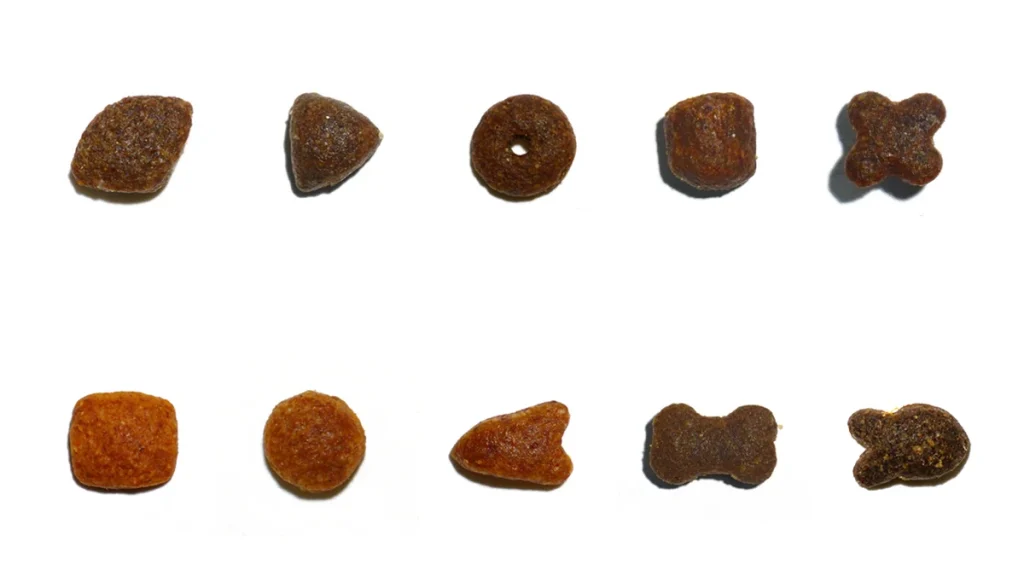
| Photo position | Pieces shown | Visible outline examples |
|---|---|---|
| Upper row | 5 | Rounded pillow, triangle-like piece, ring, short block, cross-like piece |
| Lower row | 5 | Rounded square, circle, notched piece, bone-like piece, fish-like piece |
| Total | 10 | Existing photographed examples |
The table identifies the pieces visible in the photograph. It is not a count of every mold held by the factory, and the outline descriptions are visual labels rather than official tooling codes.
Say a buyer wants the ring in the upper row: mark it directly on the image. If a second ring outline is wanted later, send another drawing, because the word ring does not identify one unique shape.
Attach the marked photo to the product inquiry. Hengsheng’s OEM dry dog food product range provides a related extruded-food reference.
For a first private label product, start with an existing outline. It gives both sides a physical reference and avoids a tooling fee.
2. How Can Ruler Photos Help Confirm Custom Pet Food Kibble Size?
A ruler photograph gives buyers a physical scale for the kibble shown, although it does not establish manufacturing tolerances. Hengsheng Pet Food’s adult dog food and kitten food photographs show actual pieces beside millimeter markings. Use these views to compare outlines and approximate size before writing a precise dimensional requirement.
【INSERT IMAGE 05 — Real Kibble Size Comparison】
Alt: Custom pet food kibble size comparison using actual samples and millimeter rulers
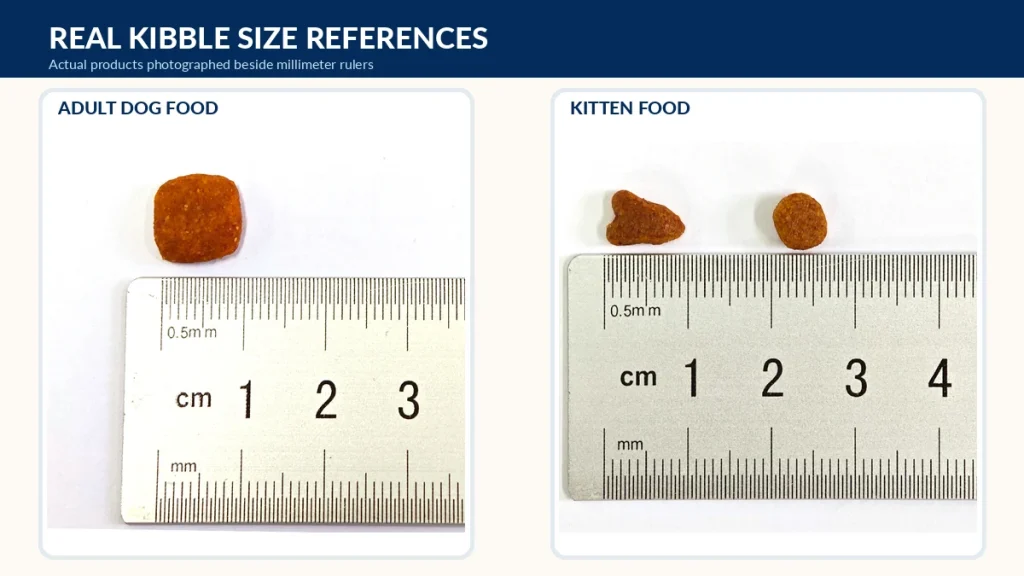
The dimensions below are approximate readings from the photographs. Both measurements describe the visible face of each piece, not its thickness.
| Real product reference | Approximate visible width | Approximate visible height |
|---|---|---|
| Adult dog food, rounded-square piece | 11 mm (0.43 in) | 10 mm (0.39 in) |
| Kitten food, irregular piece | 9 mm (0.35 in) | 6 mm (0.24 in) |
| Kitten food, round piece | 7 mm (0.28 in) | 7 mm (0.28 in) |
These paired units let US buyers compare the photos with inch-based product references. Use the values to select a general size direction; do not treat a photo reading as an agreed limit for every finished piece.
A front-facing photo also leaves the side profile hidden. A piece with the same visible outline can have a different thickness, so that feature needs its own reference.
Copying a competitor’s photo is risky for the same reason. Two pieces can look identical in a close-up and differ in real size.
3. Can I Customize Kibble Size, Thickness, and Shape?
Yes. Hengsheng Pet Food can customize the size, thickness, and shape of extruded pet food kibble. These are separate design choices: a change in face dimensions does not describe thickness, and a different outline may require a different forming arrangement. State the desired finished features individually so the request is clear.
【INSERT IMAGE 06 — Custom Kibble Size, Thickness & Shape】
Alt: Custom extruded kibble size thickness and shape options for private label pet food
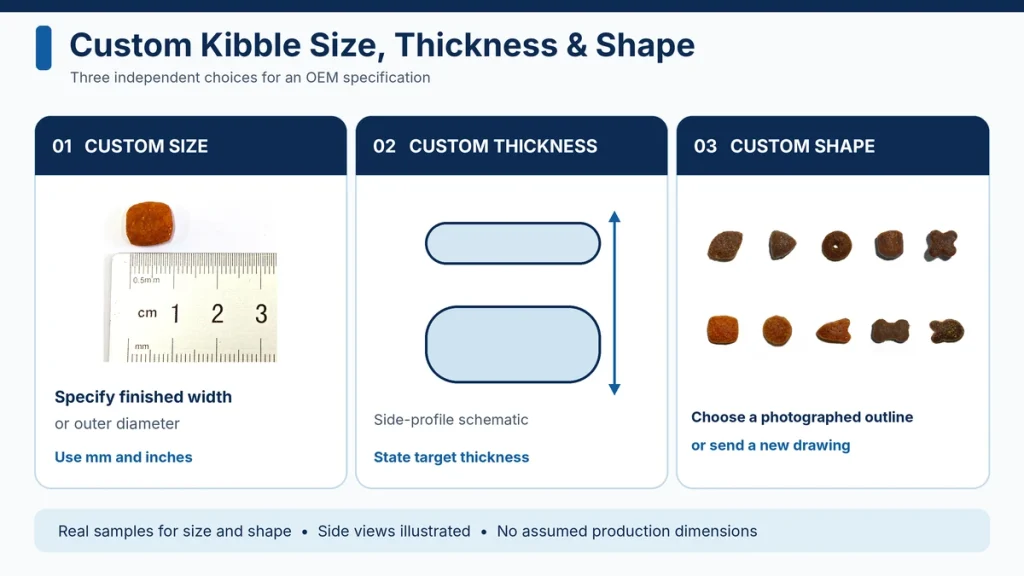
Size: Identify the Measurement Direction
For a round piece, an outer diameter may be sufficient to describe its visible face. A bone-like outline needs overall length and width because those axes are different. Provide the units in mm and inches and show where the measurements begin and end.
Thickness: Describe the Side Profile
A flatter version of an existing shape may share its top-view outline with a thicker one. Include a side-view image or a physical reference when this distinction matters, and state thickness independently from length or diameter.
Shape: Point to an Outline
Use the numbered position or a marked crop of an existing piece when its outline suits your design. You can also submit a different drawing; shapes beyond those in the existing reference can be requested.
Consider a buyer who likes the photographed ring but wants a flatter profile. That buyer can identify the ring, retain its proposed face outline, and specify a different side profile without treating the request as a completely unrelated product.
Discuss Your Custom Kibble Design
Already have a reference? Contact Hengsheng Pet Food with the selected outline and target finished dimensions. A clearly marked drawing gives the technical team a usable starting point.
4. Why Isn’t the Extrusion Die Opening the Same as Finished Kibble?
A die opening is not the finished kibble. Extruded material can expand and change shape during processing. For a custom product, describe the intended finished appearance and allow the manufacturing team to assess the forming method for that product.
Published research on extrusion processing and kibble physical properties discusses the effects of processing on kibble characteristics. The research supports the distinction between tooling dimensions and finished-product measurements; it does not supply Hengsheng-specific expansion values.
【INSERT IMAGE 07 — Extrusion Die Opening vs. Finished Kibble】
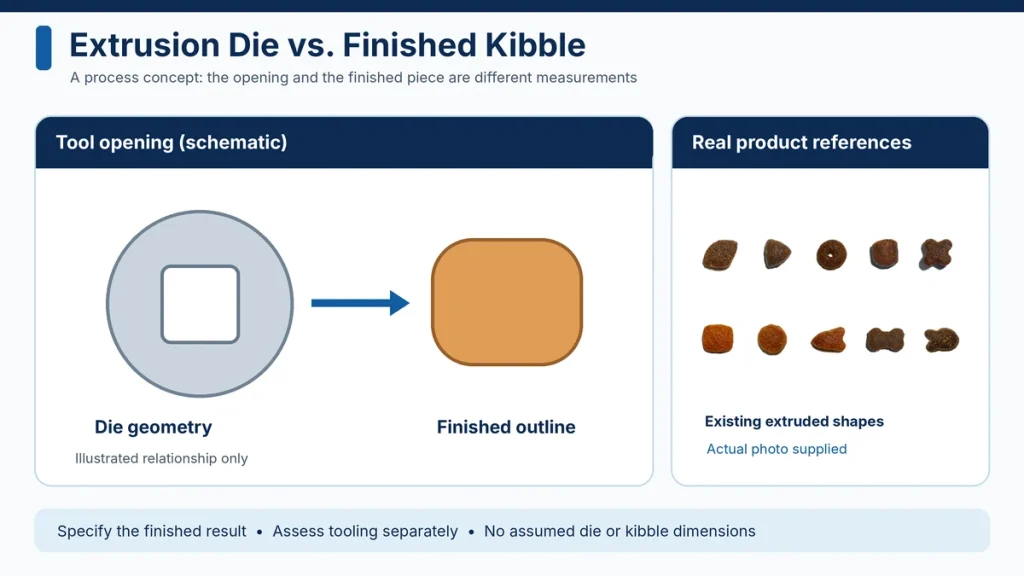
Alt: Extrusion die opening compared with finished extruded pet food kibble
A square die opening defines the initial tool geometry. The emerging piece can have rounded edges and a face dimension different from the tool opening, even though its general outline remains square. Describe the expected finished result rather than asking for a die drawing as the sole dimensional reference.
The distinction also matters when looking at different production methods. Hengsheng manufactures both extruded and low-temperature baked pet food; the two categories have different physical structures. Its differences between low-temperature baked and extruded pet food guide discusses the processes separately.
5. How Do You Write a Kibble Specification That Can Be Checked?
An OEM kibble specification should identify an approved physical reference, finished dimensions, measurement directions, and the version being reviewed. Those details make an approval usable for sample revisions and repeat orders. Set the acceptance method around the finished piece, not only a visual resemblance in an unscaled photograph or a tooling drawing.
Build the Specification Around the Approved Sample
Start with a marked reference photograph or a physical piece. Record the product or sample code, then describe which features must match: outer diameter, length, width, thickness, or a distinctive edge profile. For irregular pieces, show which axis defines each measurement.
If you are approving a revised sample, give it an unambiguous version identifier. This prevents an earlier design from being mistaken for the selected version after a later change.
Do not copy a dimensional tolerance from another food product. Use an agreed measurement method and the finished sample to establish the practical criteria for the specific geometry. When the buyer and factory use the same measurement points, the resulting record is more useful than a bare number.
A Simple Combination Calculation
Consider a buyer evaluating one shape, two proposed face sizes, and two proposed thickness options:
1 shape × 2 sizes × 2 thickness options = 4 possible combinations.
That is a planning calculation, not a required number of Hengsheng production trials. Give the selected combination its own reference so an approval email cannot be mistaken for approval of all four variants.
For the broader sequence of sample versions and sign-off, refer to Hengsheng’s OEM pet food sampling process.
6. When Does a Custom Kibble Shape Need a New Mold?
A new mold becomes relevant when the requested outline cannot be made with suitable existing tooling. Hengsheng Pet Food accepts requests for new shapes and can arrange mold development for those designs. An additional mold fee applies when new tooling is required. Ask for the tooling item separately in the quotation before authorizing development.
【INSERT IMAGE 08 — Existing Shapes vs. New Mold Development】
Alt: Existing extruded kibble shapes versus custom mold development and tooling fees
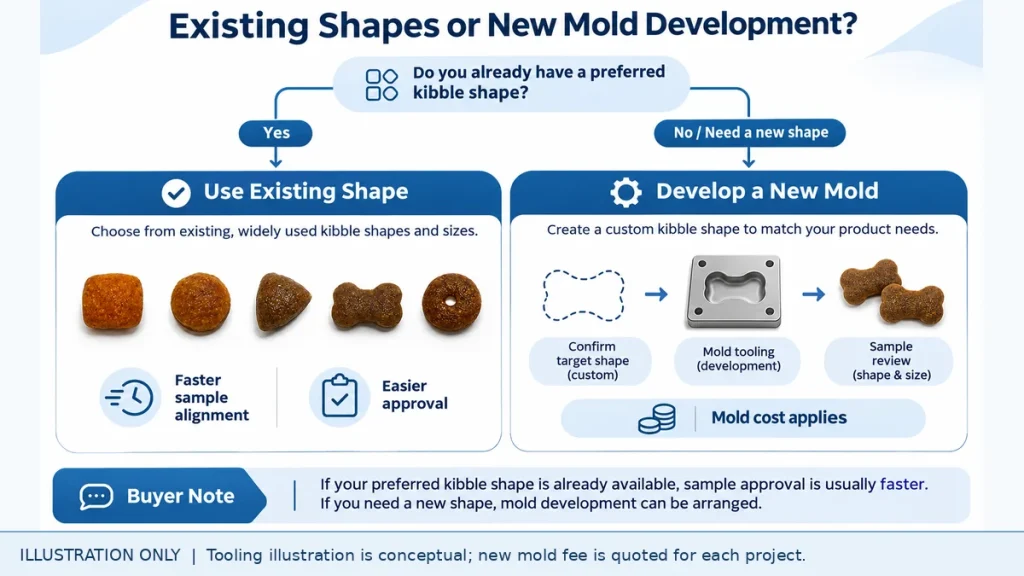
Start by comparing the proposed outline with the photographed shapes. If the visible difference is small, decide whether an existing piece meets your product brief. If the design must follow a distinct outline, send a dimensioned drawing for tooling review.
Keep the tooling item separate from the food itself in the purchasing discussion. If the drawing changes, revisit the tooling scope before treating the earlier quotation as applicable to the revised design.
Do not confuse mold approval with retail pack approval. The selected physical piece can affect how the product fills a bag; the private label pet food packaging guide addresses that later decision.
For a first launch, an existing shape is usually the simpler route. A new mold makes sense when a distinctive outline is part of the brand itself.
7. Which Kibble Customization Route Fits Your Business?
Which route you take depends on what you’re buying: a first launch, a supplier switch, or a multi-SKU range. For a first design, choose an existing reference. When transferring supply, measure the established product. For several SKUs, keep a separate reference for each.
| Buyer scenario | Recommended approach | Evidence to provide | Purchasing decision |
|---|---|---|---|
| First private label launch | Choose a photographed existing shape as a starting point. | Marked reference image | Does the outline suit the product concept? |
| Importer changing manufacturers | Match the approved physical product. | Existing piece and agreed dimensions | Which visible features must stay unchanged? |
| Distributor managing several SKUs | Maintain a distinct shape reference for each SKU. | SKU-linked photos and specifications | Can incoming goods be matched to the correct catalog item? |
| Brand seeking a distinctive outline | Submit a custom drawing for technical review. | Target outline and dimensions | Is new tooling needed for this design? |
Use the row that reflects your actual order rather than asking the factory to evaluate every possible route at once. One clear reference can make the first technical reply more useful than several loosely described alternatives.
8. Common Specification Gaps
Four gaps cause avoidable disagreements in a custom kibble brief: an unmarked shape image, a photo treated as a tolerance record, a missing side view, and a tooling request without a defined outline. Resolve these gaps in the specification so the buyer and manufacturer are discussing the same physical product.
1. An unmarked shape reference. A request for “bone-shaped kibble” can refer to more than one outline. Mark the actual photographed piece or attach a drawing; otherwise the first sample may follow a different interpretation.
2. A ruler photo treated as an acceptance limit. A real product photograph shows the approximate size of a photographed piece. It does not tell you the acceptable distribution of dimensions across a production lot. Put the acceptance method in the specification instead.
3. An outline with no side profile. A round piece can match the approved top view while having an unexpected thickness. Record the side profile separately, so both parties check the same feature.
4. A new shape with no defined tooling scope. A buyer asks for a distinctive outline without supplying its dimensions. The resulting tooling discussion may cover a different shape than the one intended. Supply the finished-outline drawing before requesting a specific proposal.
9. What Should You Send Hengsheng for a Custom Kibble Inquiry?
Send a short product brief that identifies the extruded food category, marks the desired kibble outline, and states the target finished dimensions. Include the reference image or physical sample if you have one. Ask the team to review the proposed geometry; the first message should make the intended product easy to identify.
Example OEM Inquiry
We are developing a private label extruded dog food product and would like to discuss the shape shown in the attached reference image.
Preferred outline: [marked image or drawing]. Target finished width: [value in mm] ([equivalent in inches]); target thickness: [value in mm] ([equivalent in inches]).
Please review the design against your available tooling and advise what information you need for the next sample discussion.
Send the request through the Hengsheng Pet Food contact page or email info@hengshengpet.com. You can also call +86-15322270596 or use WhatsApp at +86-182-3011-9927.
Frequently Asked Questions
Can Hengsheng customize extruded kibble size and thickness?
Yes. Hengsheng Pet Food supports custom dimensions and thicknesses for extruded pet food kibble. Describe the face size and side profile separately, using both millimeters and inches when you supply numerical targets. An existing shape photograph can identify the outline, while a side-view image communicates which thickness feature you want to change.
Can I request a kibble shape that isn’t shown in Hengsheng’s photograph?
Yes. The current photograph shows 10 existing extruded kibble examples, and Hengsheng Pet Food accepts requests for other shapes. Supply your desired outline as a clear marked drawing with finished dimensions. The manufacturer can then assess the proposed geometry against the available forming arrangements instead of guessing what the shape name means.
Are the kibble size photographs real products?
Yes. The adult dog food and kitten food photographs show real Hengsheng product pieces alongside rulers. The markings provide a physical scale for the individual pieces shown. Values estimated from the image remain approximate; the photograph is useful for visual comparison, while a commercial dimensional requirement needs a separately defined measurement method.
Is the extrusion die opening the same size as finished kibble?
No. Extruded material can expand and change shape after it passes through the die, so the tool opening and finished dimensions are different measurements. Describe the target appearance on the finished product and identify which axes matter. The manufacturing team can then discuss how the proposed geometry relates to the forming process.
Can I change kibble shape without changing the formula?
Usually yes. You can request a new shape on an existing formula. The proposed geometry still needs a technical review to establish whether it can be formed with that recipe. Review a new finished sample before using the revised shape as the accepted product reference.
Is there an extra charge for a new kibble mold?
Yes. Hengsheng Pet Food charges an additional tooling fee when a requested shape requires a newly developed mold. Begin by identifying the existing reference or supplying the proposed outline. Keep the tooling item distinct from the food order in the purchasing discussion so both parties are referring to the same design.
What should an importer provide when matching an existing kibble product?
Provide the existing physical piece if available, along with clear top and side photographs. Record the dimensions you need to match and identify the measurement directions. If you already use a product reference code or approved sample version, include it. These details give the manufacturer a defined target for the comparison.
Final Advice: Describe the Finished Piece Clearly
The most useful OEM kibble inquiry identifies the intended outline and states which physical characteristics matter. Hengsheng’s real product references provide a starting point for that conversation; a dimensioned brief makes the requested change easier to evaluate.
Avoid treating shape, size, and thickness as interchangeable words. Describe the finished piece in terms another person can measure.
Discuss your custom kibble project: Contact Hengsheng Pet Food with the marked reference and the dimensions you want to review. Email info@hengshengpet.com or call +86-15322270596.